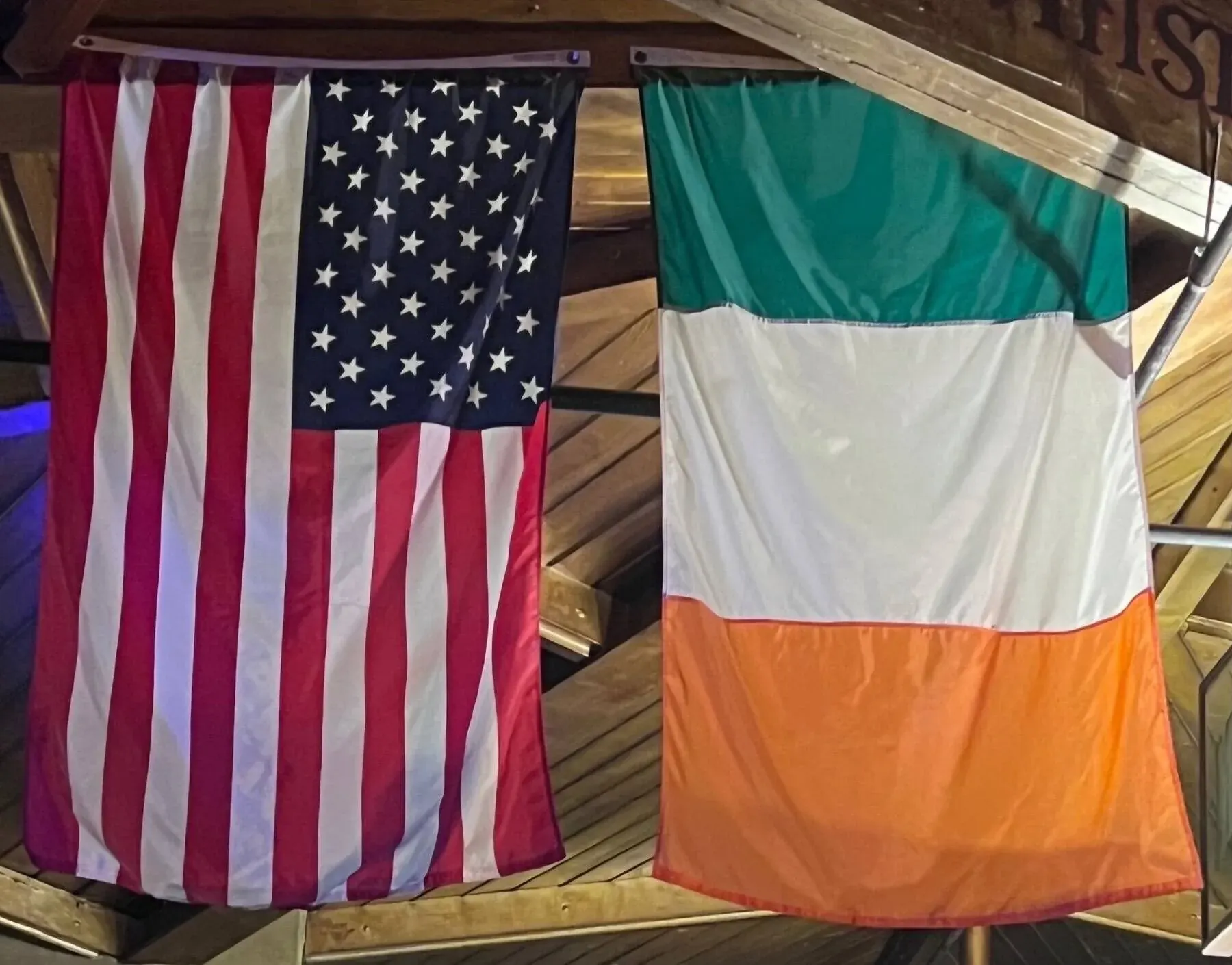
I carry my grandparents' wedding photograph with me everywhere I go. My grandmother left the family farm in Broadford, boarded a ship, and crossed the Atlantic in the 1920s. In time she met my grandfather, who was also Irish, and they built a life. I think about that photograph every March, when millions of people celebrate being "Irish for a Day" -- green rivers, stout pints, parades through hundreds of American cities. It is an extraordinary cultural export for a country of 5.4 million people. What the celebration rarely mentions is what it cost to get here.
The story we tell now is one of triumphant integration: the Irish fought their way out of poverty, built the cities, and rose to power. We tell ourselves the narrative of the American "Melting Pot" as a linear, successful process. The story we forget is the one of structural violence that made that journey necessary. When millions of Irish Catholics began to arrive in the 19th century, fleeing famine and desperation, they did not meet the American Dream; they met an American Nightmare. For generations before they arrived, the Irish had lived under British domination, stripped of land, language, and political power. The famine was not just a natural disaster but a deliberate colonial one, and the prejudice that defined them under the empire followed them across the Atlantic.
They didn't land in a country that recognized them as fellow white men. They were greeted with a hostility so intense it went beyond xenophobia. They weren't just disliked; they were racialized and dehumanized. The Irish were often depicted in the media as a subhuman, drunken, and violent race whose presence was a threat to the purity and stability of the United States. Their Catholicism was seen as an allegiance to a foreign power and a direct threat to Protestant democracy. This fear fueled the murderous nativism of the Know-Nothing movement, which organized not merely to exclude, but to actively suppress and assault the Irish, burning churches and attacking neighborhoods.
Economic exclusion was also pervasive. No Irish Need Apply signs were real, locking them out of skilled trades and forcing them into the most dangerous, low-wage labor, including building canals and railroads that often buried them. The same system that exploited their desperation to secure cheap labor simultaneously used their existence to spread the fear of lower wages for everyone else.
The Irish-American answer to this systematic abuse was not quiet assimilation; it was the creation of a uniquely American counter-narrative. The boisterous, green-drenched St. Patrick's Day parade we celebrate today was born not out of religious custom in Dublin, but out of political and social necessity in cities like New York and Boston. It was survival. This massive, secular spectacle became a yearly demonstration of power, a loud, collective assertion of identity designed to make the Irish too visible, too numerous, and too organized to continue to be ignored.
This power was most effectively leveraged through the rise of urban political machines. Organizations like Tammany Hall in New York City recognized the political gold in the vast, mobilized Irish voting bloc. These machines didn't offer assimilation or acceptance; they offered a pragmatic path to survival. In exchange for reliable votes, the Irish immigrant was given a job in the fire department, a helping hand with housing, or essential resources. By dominating these city services, the Irish secured institutional power and stability, an invisible infrastructure of support that solidified their economic and social foothold and decisively began their transition from a racialized, foreign threat to an integrated component of the American mainstream.
As a second-generation Irish American, I never experienced the structural violence that millions of our ancestors encountered when they reached our shores. I grew up in an era after the cementing of the Irish presence in America: the election of the first Irish and Catholic President, John F. Kennedy.
My grandparents' photograph also reminds me that every immigrant story carries both gratitude and grief. They, along with millions like them, built a foundation that I stand on today. But the Irish story was never unique. It's one chapter in the larger, repeating American script of who gets to belong and when.
The Irish experience sits beside dozens of others: Italians branded criminals; Jews painted as conspirators; Poles, Hungarians, and Slavs dismissed as dull laborers; and Greeks accused of being unclean or unfit for democracy. Each wave was told in different accents but set in the same story, you don't belong here. Through exhaustion and persistence, each learned how to move from a vilified outsider to an "acceptable" American.
What often goes unspoken, however, is that these European groups carried a structural advantage that today's immigrants do not. They arrived during an era of virtually open borders. There were health inspections, but no national quotas or numerical limits on European entry until the National Origins Act of 1924. In effect, millions of our European ancestors were never branded "illegal" because federal policy didn't yet make that category. For Asian immigrants, this was entirely different as they confronted a federal system designed to exclude them legally. As a result, America built its modern concept of illegality on these racial hierarchies, locking the door behind those who had already walked through it and ensuring that future arrivals would face structural barriers many of our ancestors never did.
Acceptance was conditional. It depended on how quickly each group could distance itself from the next newcomers at the gate, a quiet bargain built into the story of American assimilation.
The Irish eventually won acceptance through jobs, political power, and the right shade of "whiteness." But in doing so, many of us forgot how precarious that status once was. We traded memory for membership.
Remembering that fragility matters, because the same doors that once opened for our families are closing for others. Today, we are witnessing the modern-day equivalent of what successive waves of immigrants endured, which is why the rhetoric that fills our news and social feeds feels so hauntingly familiar. The vicious dehumanization of Hispanic migrants at the border, the reflexive suspicion cast on Muslim neighbors, and the othering of African immigrants are not new patterns. They are the same toxic traditions of racialized fear, merely re-aimed, that once battered our own ancestors.
When we call people "illegals," "invaders," or "un-American," we aren't just using crude slang; we are using the vocabulary that greeted previous immigrant communities, a vicious tradition of exclusion passed down through generations. And the terrorizing images of ICE raids, deportations, imprisonment, and family separation are the 21st-century version of the Know-Nothing mobs. The purpose remains chillingly identical: to use state-sanctioned fear and violent disruption to keep an immigrant desperate, destabilized, and forever excluded. To forget that history is to dishonor the courage of those who endured it.
And yes, Saint Patrick's Day will be upon us again. Enjoy the celebration. But remember that honoring the Irish story is not about a single day in green -- it's about whether we extend to the next arrivals the humanity that was so brutally withheld from the ones who came before them.