Issue 02 · May 29, 2026
There is a neighborhood grocery store near the corner of Coombs and Ash that most visitors never see. I found it on an ordinary Tuesday morning.
I had been walking through Fuller Park and down South Jefferson Street with no destination in mind. Just the kind of wandering I had come to rely on after a few years of living this way, moving through neighborhoods slowly enough to notice what surfaced.
By the time I reached West Imola Avenue, the morning rush had mostly passed. The crossing guards were gone. Parents had walked their kids to school and headed home. I turned onto Coombs Street to make my way back. A few blocks down, street crews were repairing a sidewalk.
Then I stopped. I wasn't sure what I was looking at before I knew it mattered.
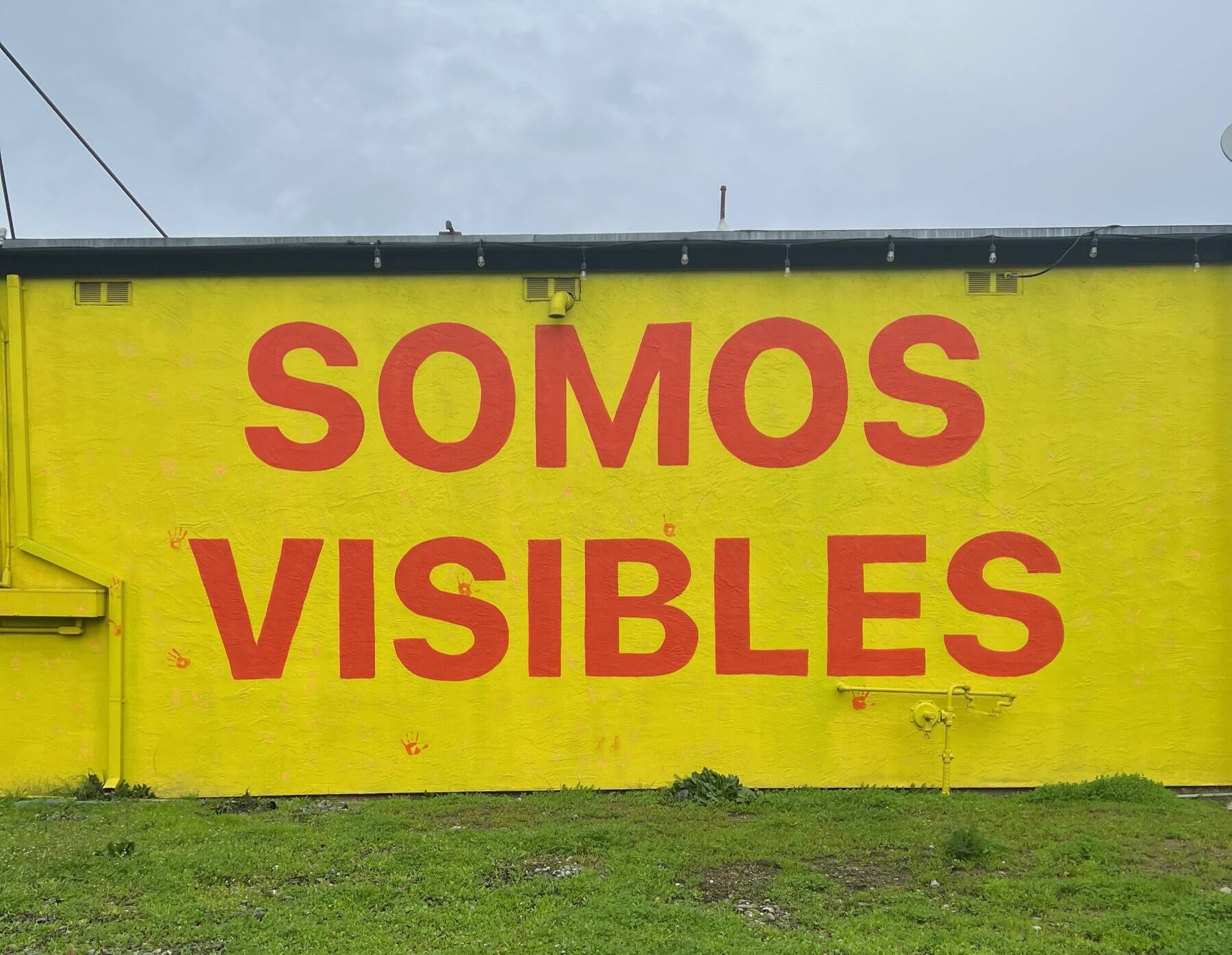
On the side of A1 Food Store, someone had painted two enormous words in bold orange letters on a neon yellow wall.
Impossible to miss. Impossible, really, to look through.
SOMOS VISIBLES
I stood there for a while before taking the photo. There is something about street art that rewards stillness. The longer you look, the more you notice.
What struck me was the certainty of it. Not see us. Not we want to be visible.
A declaration: We are visible.
As if saying it loudly enough, brightly enough, publicly enough might make it permanently true.
I later learned the mural was created by artists Arleene Correa Valencia and Giancarlo Grabella, who owns Olde Town Barbershop. The phrase started as a T-shirt design. With Tony's approval, they painted it onto his store wall in July 2021, and invited neighbors to add their handprints as a sign of solidarity for the local community and immigrant farm workers.
Napa may be one of the most photographed places in America. The vineyards. The terraces. The late afternoon light that seems designed for a camera. The name itself has become shorthand for a particular kind of American aspiration: beautiful, curated, expensive.
But every place has a marketed story and a lived story. South Napa is part of the lived story.
It is where many of the people who sustain that image actually live. The people fixing roads on Tuesday mornings. Working kitchens. Cleaning hotel rooms. Harvesting vineyards. Stocking shelves. Raising families in the shadow of one of America's most aggressively branded luxury landscapes.
Coombs Street does not appear on most tasting itineraries. Which is exactly why the mural is there.
The vineyards that define the valley's image are visible from South Napa. The people who tend them look at those same vineyards from their apartments on the way to work. The label shows the vineyard. It does not show the workers.
As an Irish-American, I have thought about the Irish more than once since seeing that wall. What it was like for many to arrive in a country that looked through them, and how Saint Patrick's Day parades were not invented in Ireland. They were created in America by immigrants who arrived in cities that looked through them. The parades were celebrations, yes, but they were also declarations: we are here, you will see us.
Over time, many did. Slowly. Imperfectly, like every community that eventually gains belonging. Still, the instinct feels familiar. A community refusing invisibility. Painting itself into public memory. Making itself too visible to ignore.
America debates ideology on our screens, but after walking streets like Coombs, I've come to believe visibility is rarely granted. It is claimed. In stories, rituals, stubborn acts of presence. In walls painted bright enough that no one can pretend not to notice.
And maybe that is where so many leaders, institutions, and movements still get it wrong. They mistake representation for recognition.
Being counted is not the same as being seen. Being marketed to is not the same as being understood. Being talked about is not the same as being heard.
The mural is still there. Tony kept it.
Because some messages are not meant to be temporary. They are meant to stay on the wall until the rest of us finally see what was already there.
-- Michael Holland
Finding America chronicles a multi-year odyssey through the places, histories, and myths that shape American life.
Since 2022, Michael Holland has lived in more than forty communities, exploring what becomes visible when we slow down, stay longer, and experience places on their own terms. It is a search for a country that is often very different from the one we debate.
The odyssey continues.