Issue 08 · July 10, 2026
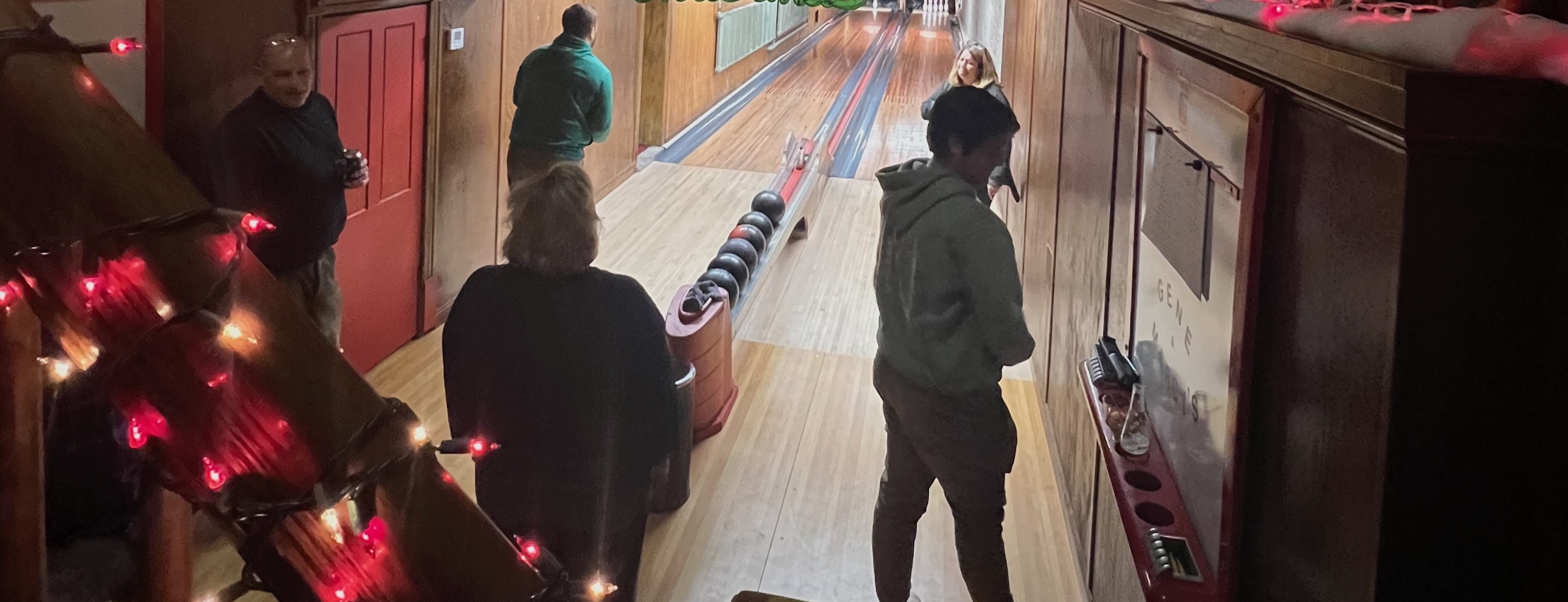
There is a family-owned tavern on Milwaukee's South Side where the bowling pins are still reset by hand.
The two lanes are in the basement, beyond an opening at the end of the bar and down a short flight of stairs. At the far end, a red wooden facade hides most of the work. You catch pieces of the pinsetters as they move behind it. A pair of shoes. Someone bending low to gather the fallen pins. An arm reaching across the lane. Then the pinsetter disappears again. Ten are set back in place. The game continues.
I came to Milwaukee because I wanted to visit Wisconsin before my nephew's wedding, and a friend insisted I could not leave the city without seeing Holler House. Until that evening, I had never heard of it. On the drive over, she explained that it was the oldest sanctioned tenpin bowling alley in the United States still using human pinsetters. I understood the words. I did not understand the place.
The tavern has belonged to the same family for more than a century. It began as Skowronski's in 1908, opened by Mike Skowronski. Gene Skowronski was born in the apartment attached to the tavern, and in 1954 he and his wife, Marcy, took it over from his parents. Marcy became a legend. In the 1970s, a neighbor complained about all the hollering coming from inside. Gene and Marcy changed the name. The name stayed. So did the family. Their daughter, Cathy Haefke, now owns and operates Holler House with her husband, Tom.
The bar was full that night. Red walls. Old wood. Photos and memorabilia. A holiday party had taken over one corner while regulars came and went around it. My friend spotted Cathy near the bar, surrounded by people. She wanted to introduce me, so we ordered a beer and waited for an opening.
When Cathy finally turned toward us, my friend made the introduction and told her I was living in Milwaukee for the month. It was my first time at Holler House. She smiled. Then she started telling me the story.
She talked about her mother. About growing up in the tavern. About keeping it going. About her grandchildren. Every few minutes, someone stopped her or needed her at the bar. She had plenty of reasons to keep moving that night. She kept coming back.
I have been in a lot of bars. Holler House felt different.
It felt less like a business than a weekly family reunion that happened to serve beer. People greeted one another without ceremony. Some had clearly known each other for years. Others seemed to have simply fallen into conversation because that is what people did there. The holiday party continued as pairs disappeared downstairs to bowl and came back up for drinks.
The place had an ease to it. Not the kind designed by someone. The kind practiced. Nobody had decided to create a sense of community. They had simply kept the place open.
I went back downstairs one more time. Another frame ended. The pins fell. Behind the red facade, someone bent down. A few seconds later, ten pins were standing again. As I stood there watching, I realized the oldest thing in the room was not the bowling alley. It was the expectation that someone would be there tomorrow.
For more than a century, someone in the family has unlocked the front door. Most of those days were probably unremarkable. They unlocked it anyway.
Downstairs, the pins fall. Someone puts them back.
I came to Milwaukee for Spotted Cow and fried cheese curds.
What I remember is that the lights were on.
-- Michael Holland
The full journey -- forty communities, twenty-eight states, three continents -- lives at michaeljholland.com.
Finding America chronicles a multi-year odyssey through the places, histories, and myths that shape American life.
Since 2022, Michael Holland has lived in more than forty communities, exploring what becomes visible when we slow down, stay longer, and experience places on their own terms. It is a search for a country that is often very different from the one we debate.
The odyssey continues.