The Words That Didn't Survive
On handwriting, revision, and the drafts behind two American songs
On handwriting, revision, and the drafts behind two American songs
I was standing inches from Bob Dylan's handwriting when I stopped looking at the song and started looking at what had happened to it. The page was crowded with work: lines crossed out, words inserted, verses numbered and renumbered, phrases written over other phrases. The handwriting itself was difficult for me to decipher in places, but the revisions were unmistakable. Some words had survived whatever Dylan was trying to do. Others had been abandoned along the way.
I knew Dylan through the finished songs. My way into his work had come partly through Bruce Springsteen, especially his performances of "Chimes of Freedom," and by the time I visited the Bob Dylan Center in Tulsa, I thought of Dylan as one of the great users of language, someone whose words had traveled far beyond the circumstances in which they were written. The museum offered plenty of ways to encounter that Dylan through recordings, videos, photographs and objects from his career, but I kept returning to the handwritten pages.
There was something different about encountering the work in that condition. A song that had reached me as something complete had once been unsettled: words tried and discarded, lines moved, possibilities left on the page after different ones had taken their place. I had always known that writing involved revision. There was nothing revelatory about that proposition. But the finished song concealed the decisions that had produced it, while the page preserved at least some of them.
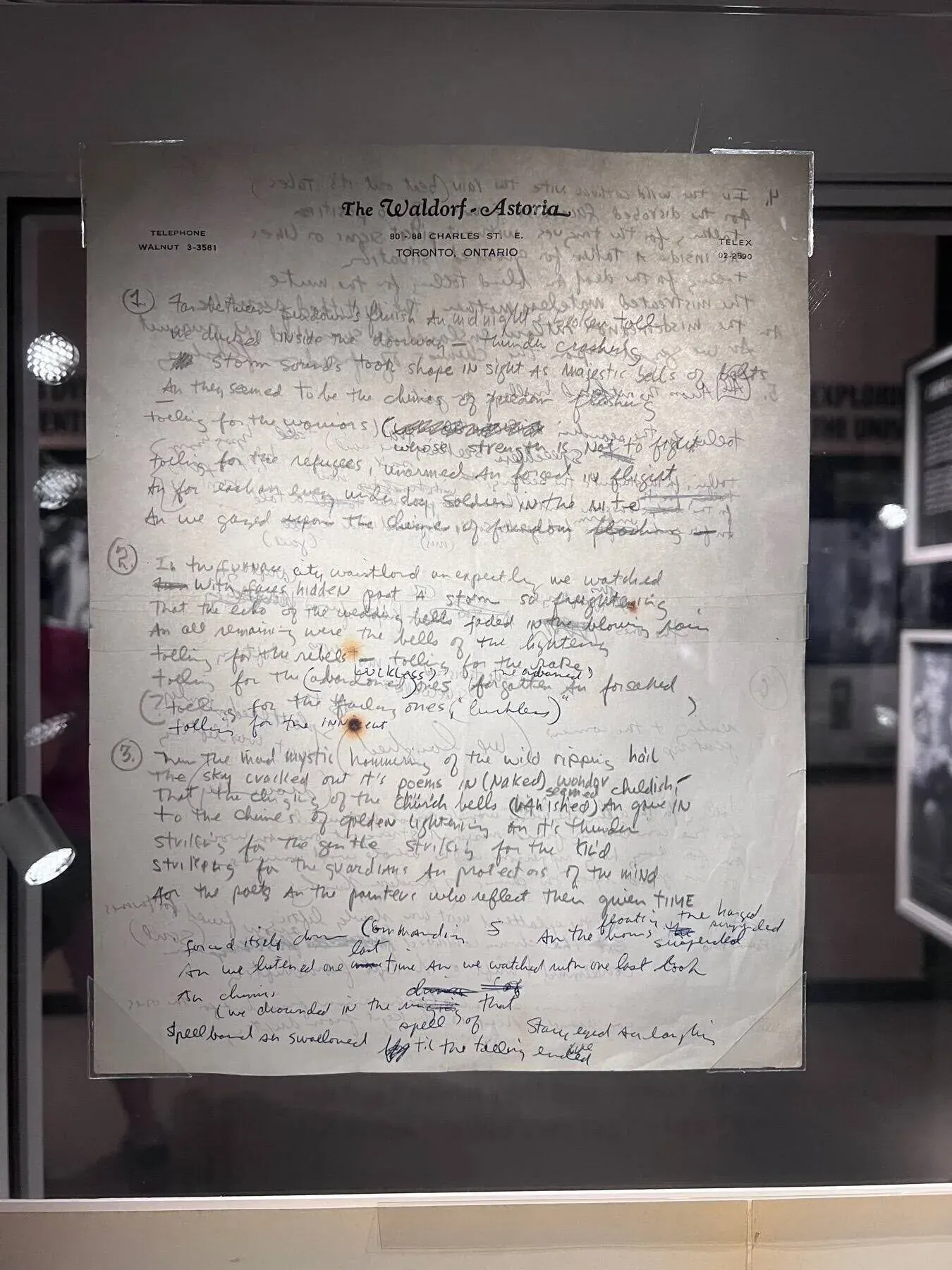
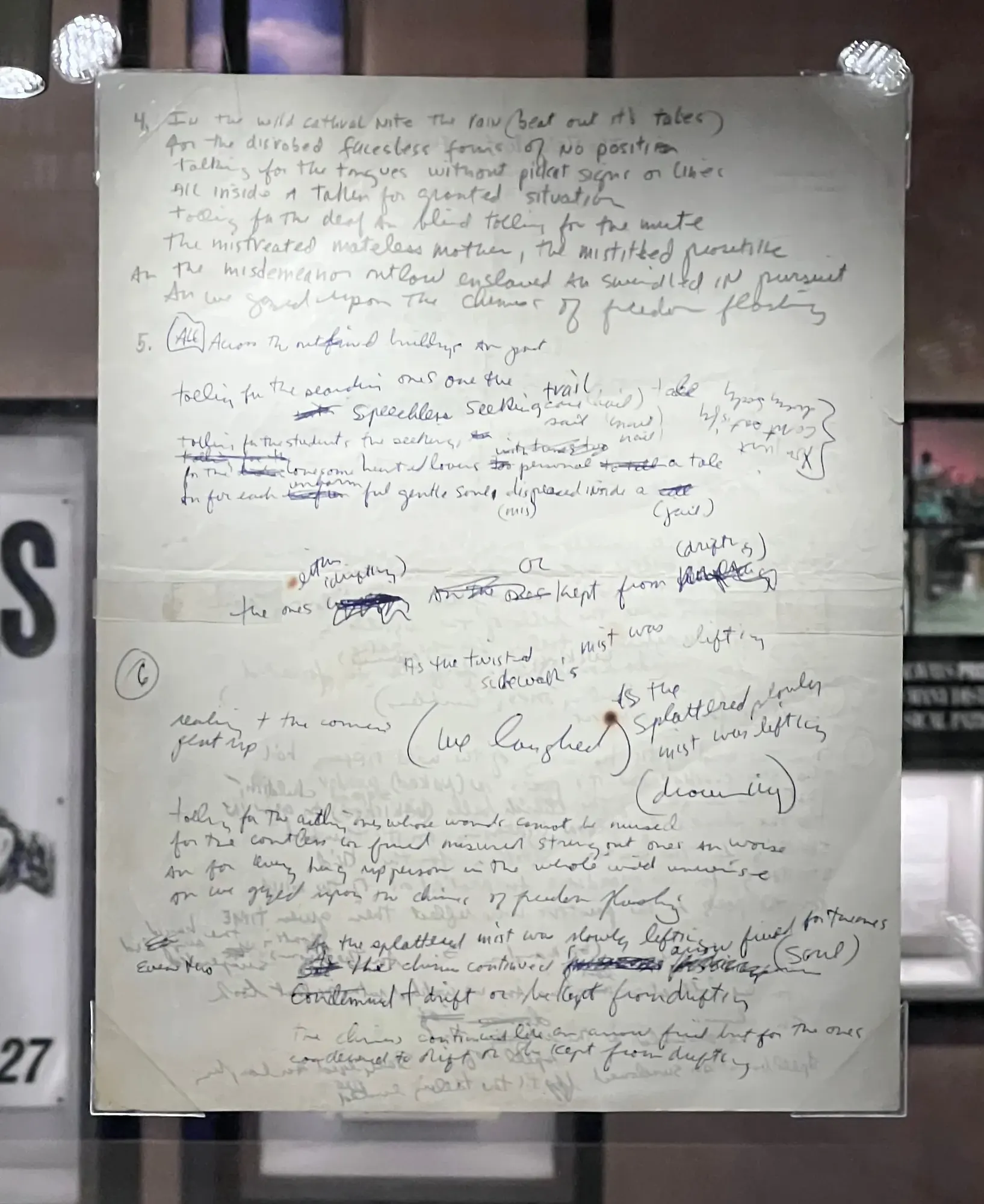
Working manuscript pages for "Chimes of Freedom," Bob Dylan · Bob Dylan Center, Tulsa, Oklahoma (Michael Holland)
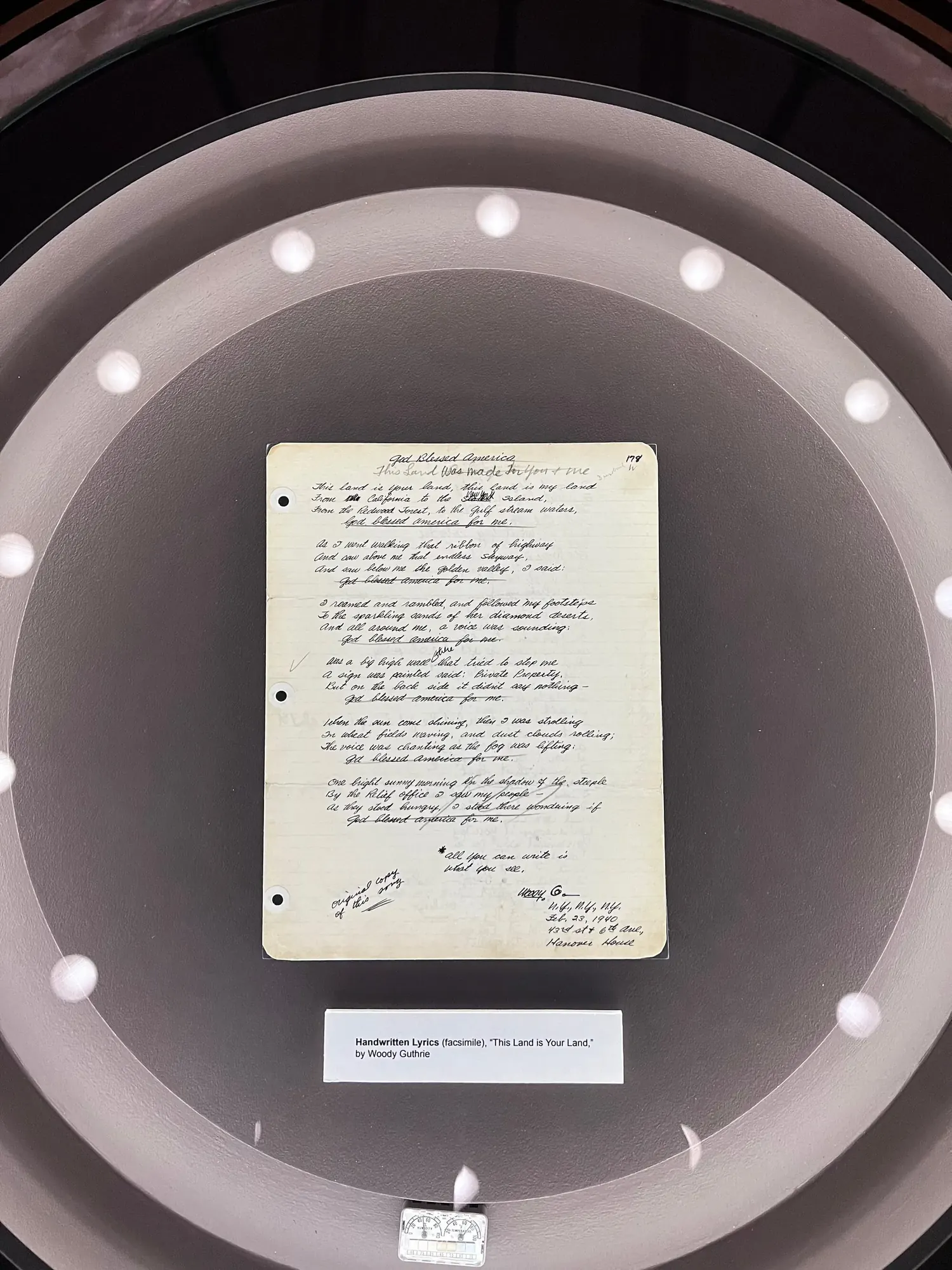
Later that same day, I went to the Woody Guthrie Center. Guthrie had also entered my life partly through Springsteen, this time through his performances of "This Land Is Your Land." Inside the center were objects that immediately announced the Guthrie I already knew: the guitar, the songs, the public figure associated with protest and working people. Behind glass, though, was a handwritten version of "This Land Is Your Land."
The page was worn and creased, with three punched holes along the left edge. At the top, "God Blessed America" had been crossed out and replaced in Guthrie's handwriting with "This Land Was Made for You & Me." Below it were verses I knew as a song, but here again the finished work had been returned to an earlier state. There were alterations and changed words, with other possibilities still visible on the page. Near the bottom, Guthrie had written a note: "all you can write is what you see."
Seeing another handwritten draft on the same day made it harder for me to regard these pages simply as memorabilia. At the Dylan Center, surrounded by the evidence of a celebrated career, my attention had settled on crossed-out words and substitutions. At the Guthrie Center, it happened again. Two artists I knew through finished work had been returned, at least for a moment, to the condition in which some of that work was still being decided.
A word had once seemed right enough to write down and then not right enough to keep.
That was what the pages preserved. A word had once seemed right enough to write down and then not right enough to keep. A line had occupied a place until another displaced it. What eventually survived into songs that people would record, perform and memorize remained on the page beside traces of possibilities that did not.
Nothing about seeing those drafts diminished the finished songs for me. If anything, the pages made their completeness seem stranger. By the time a song reaches us, most of the choices that produced it have disappeared. Here, some of them were still visible.
Months later, when I tried to explain what had stayed with me from those two museums, I returned to the same details: the drafts, the crossed-out words, the substitutions and revisions. "You see the drafts," I said, "so it becomes that appreciation for the craft." I had known the songs long before I arrived in Tulsa, but when I think back on those two museums now, what I can still see are the pages.