Issue 04 · June 12, 2026
Put me in Wrigley Field, MetLife Stadium, or almost any other baseball or football stadium and I know exactly what to do. I understand the rituals. I know when to stand, when to cheer, and when to start making my way toward the exit. Sports have a way of creating their own language, and in those places I am at least conversational.
Talladega was different.
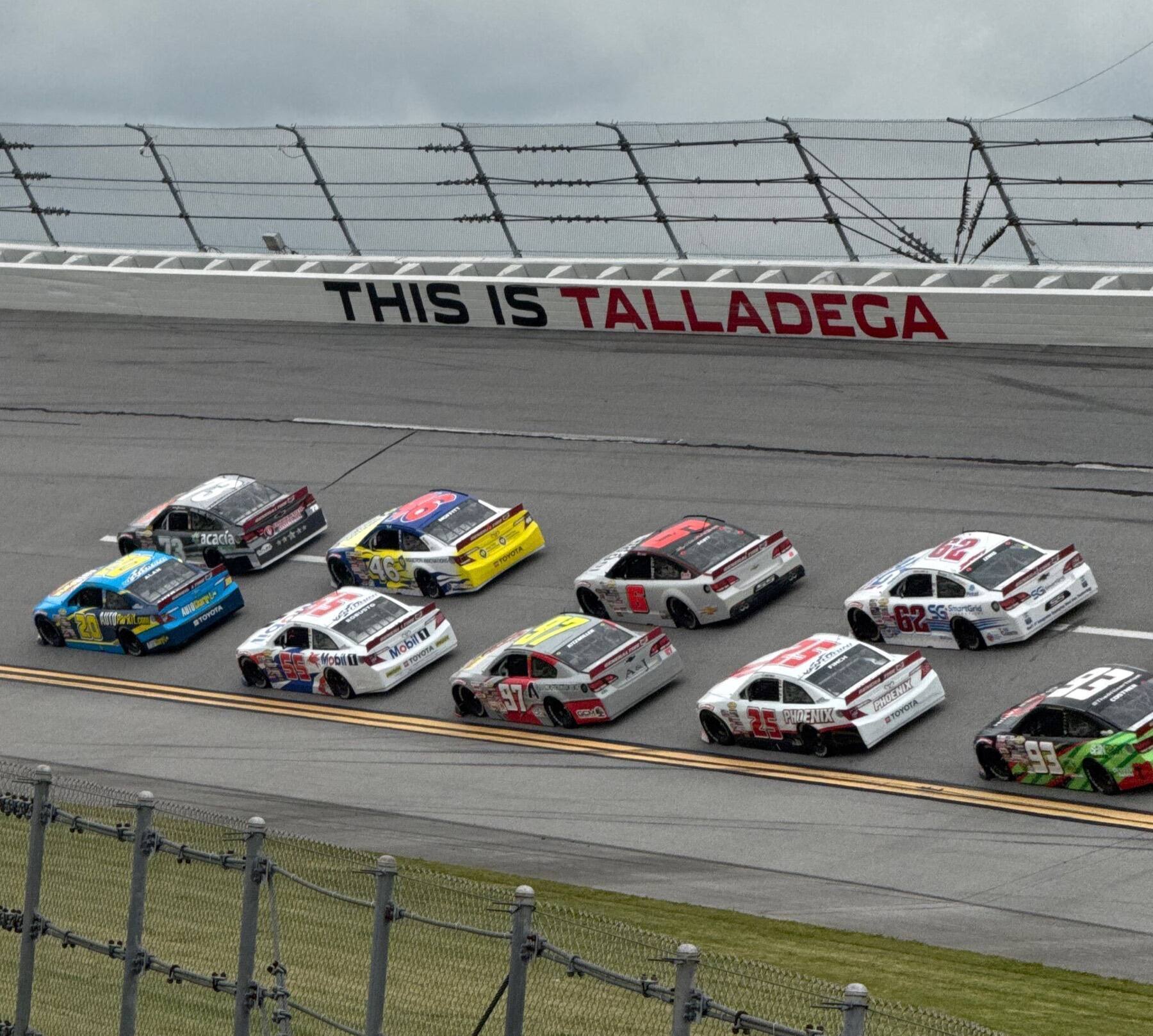
Long before you reach the track itself, you begin passing campgrounds and parking lots already beginning to fill. Then you drive beneath the entrance to the speedway and under the track into a world that feels less like a sporting event than a temporary city. RVs in the infield stretch to the horizon. Tens of thousands of people arrive to inhabit it. Some come for a weekend, while others have been returning to the same patch of grass for decades.
And just about everyone has a number.
They are everywhere: on flags hanging from RVs, decals on coolers, shirts, hats, and canopies. They are not simply favorite drivers. They are identities and allegiances. People do not just support a driver. They belong to a tribe. They know the history, the rivalries, the disappointments, the victories, and the grievances. They know who switched teams, who wrecked whom, and who should have won a race years ago.
I quickly realized I had made a rookie mistake. I arrived without a number.
Part of the problem was that I am not a car guy. Talk to me about torque, RPMs, or gear ratios and I am quickly out of my depth. But when my brother-in-law invited the men in the family to spend a weekend at the races, saying yes seemed a lot more interesting than saying no. What I had not fully realized was that I was stepping into a culture with its own language, rituals, loyalties, and mythology.
Which was fitting, because I had also arrived carrying a set of assumptions. Assumptions that were shaped entirely from television, movies, and social media. Stereotypes accumulate when you know a place from a distance rather than experience.
The first crack came from the race itself.
The cars arrive like a force of nature. No screen had prepared me for the sound or the speed. Forty drivers traveling at nearly 200 miles an hour, separated by inches, making decisions with almost no margin for error. You stop thinking about it as a sport and start thinking about it as something that should not be possible. And even with earplugs, each lap sounded like a jet passing overhead. You heard them, but you also felt them. Standing at the fence near the track, the pressure hits you square in the chest.
But the bigger surprise was everything happening away from the track.
Most evenings we wandered through the infield and eventually ended up on Talladega Boulevard, the unofficial main street of the temporary city. Everywhere you looked people were reconnecting with friends, swapping stories, sharing food, and talking about how many years they had been coming back.
Same hunger. Different soundtrack.
One afternoon I noticed a Harley-Davidson shirt from Wall, South Dakota.
Now if the image of me standing on top of an RV holding a beer in the Alabama sun is already unexpected, imagine his surprise.
Wall has fewer than a thousand residents and sits near the Badlands in western South Dakota. When I shouted over that I loved Wall Drug, he turned around with a look somewhere between confusion and amazement. From neighboring RV rooftops we ended up talking about the Badlands, Sturgis, the Harley-Davidson Museum in Milwaukee, and places neither of us expected the other to know. We were friends for the weekend.
What struck me was how often some version of that happened. The more conversations I had, or overheard, the less useful my assumptions became. People talked about how far they had driven, who first brought them, and which campsites their families returned to year after year. What I kept hearing was not just loyalty to a race. It was loyalty to one another. For many of them this is not just any weekend. It's a reunion. A rite of passage. And for some, it is a pilgrimage.
The Burners would recognize this feeling instantly. So would anyone who has driven across three states for a music festival and called it the best week of their year.
Who I was when I arrived in the infield on Thursday and who I was when I left on Monday morning were not entirely the same. Not because Talladega dramatically changed my views or suddenly turned me into a huge NASCAR fan. It changed something smaller and more important. It forced me to confront how much of what I thought I knew had been assembled from a distance.
I don't know if I'll ever get back to Talladega Superspeedway, but I know that every spring when the race rolls around, I'll think about that weekend with my family. I'll think about the conversations on Talladega Boulevard, the neighbor from Wall, South Dakota, and the people who welcomed a newcomer into a tradition that had been theirs long before I arrived.
For a few days I stopped being a spectator and became part of the community itself. Beneath the flags, the numbers, and the noise was something far more familiar: people gathering around a shared ritual, returning to the same place, and finding one another again.
I keep looking for a place and find people instead.
-- Michael Holland
Finding America chronicles a multi-year odyssey through the places, histories, and myths that shape American life.
Since 2022, Michael Holland has lived in more than forty communities, exploring what becomes visible when we slow down, stay longer, and experience places on their own terms. It is a search for a country that is often very different from the one we debate.
The odyssey continues.