Issue 05 · June 19, 2026
It was not my proudest moment.
I was walking along South Main Street in Memphis when three women stopped me and asked a question. No matter where I am, people seem to ask me for directions, which I have decided is some kind of compliment. At the time I was doing what I normally do, wearing my headphones and listening to music or an audiobook as I walk. By the time I pulled out my headphones, the only word I clearly caught was motel.
I filled in the rest myself.
Memphis draws people from all over the world, and that part of town has plenty of hotels, restaurants, and places people are trying to find. So I said something like: "Do you have the address? There are a lot of hotels and motels around here."
I remember the look on their faces. Surprise. Disappointment. Disbelief.
It took me another second to understand what they had actually asked. They were looking for the Lorraine Motel, and I had just walked past it.
There were any number of better ways to handle the moment. I could have simply said: "I'm sorry, I didn't hear you with my headphones in." Instead I answered the question I had imagined. I was in my own world, moving through one of the most historically weighted areas in America while failing to register what was right in front of me.
I had come to Memphis to pay attention. And even there, I was capable of missing the obvious. In hindsight, the mistake felt less like an accident than a preview.
My relationship with Memphis began long before I arrived.
My doctor was the older brother of Marc Cohn, the Grammy Award-winning singer-songwriter best known for his 1991 song "Walking in Memphis." I was a senior in college when that song came out, and from that point on I wanted to know what it actually felt like to walk with my feet ten feet off of Beale.
It would be years before I got there, first on a business trip with a night at B.B. King's and a tour of Graceland. But the desire to come back was always there. Memphis is known as the Home of the Blues, the city of Beale Street and the Peabody ducks, of Graceland and Sun Studio. That is the marketed city, and it is real. Half a mile away is a different story entirely. I walked that half mile more than once.
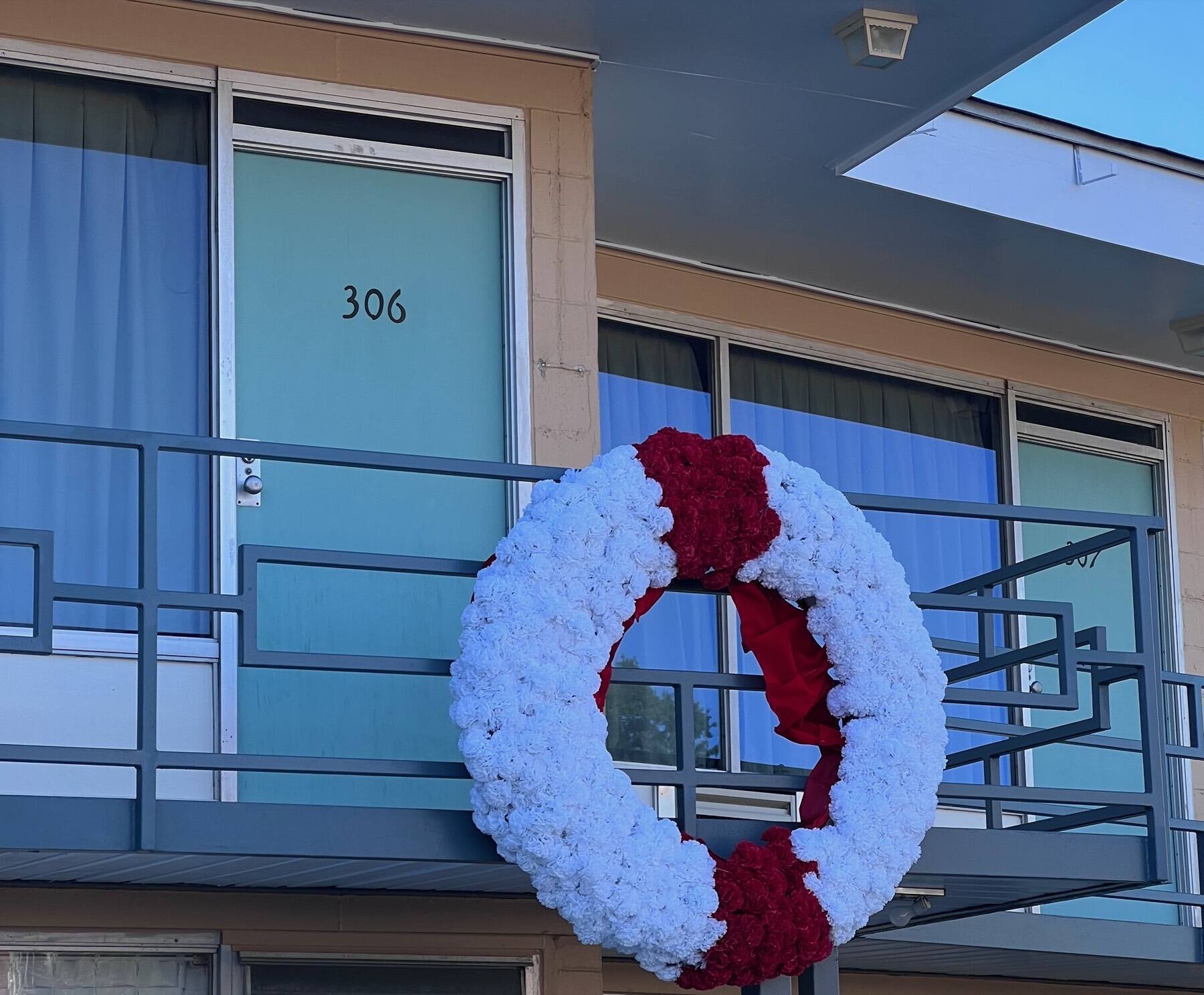
To stand beneath the balcony of room 306 at the Lorraine Motel is to feel the distance between what America promised and what it delivered collapse into a single point.
The room and the parking lot are still largely frozen in time from the morning of April 4, 1968, when Dr. Martin Luther King Jr. was assassinated on the balcony above. He was in Memphis to support the sanitation workers' strike. I spent an afternoon on one of the benches below, staying long enough for the weight of the place to settle.
To stand outside the Lorraine Motel is one thing. To enter the National Civil Rights Museum is another.
The staff greet you with a warmth that feels almost protective, as if they understand what you are about to move through. Inside, the story gathers force slowly. The face of Emmett Till. The buses. A replica of the Birmingham jail cell where Dr. King wrote his letter, and you understand, standing inside it, how small the space was, how large the voice that came out of it.
The museum doesn't ask you to wander. It guides you. Room by room, decade by decade, the path narrows toward Memphis, toward the sanitation strike, toward the I AM A MAN signs, until eventually you turn a corner and find yourself standing between the two motel rooms.
What stays with me most is the physical closeness of everything. You see the room where Dr. King stayed. You see the room across the way where his team gathered. You stand near the balcony. You understand the distance from which the shot came. It is one thing to know the photograph of people pointing toward the boarding house. It is another to stand there and feel how near it all was.
The violence does not feel abstract at that distance. It feels like something that never fully became past tense.
That is what I keep finding as I move through this country. Not just history. Wounds.
Places where something happened that was never fully reckoned with, never fully healed, and where the gap between the official story and the felt one is still visible if you stay long enough to feel it.
Memphis carries it on a balcony where a man who asked America to live up to its own promises was murdered before the country ever fully answered him. Five decades later, we are still being asked.
Maybe that is why the moment with the three women stayed with me. Not because it was dramatic. It was not. Not because I failed in some unforgivable way. I did not. It stayed with me because it revealed something I did not want to see about myself.
I had come to Memphis to pay attention. I had read about the city, walked its streets, done the research. And still I answered the question no one had asked.
It is possible to be near something and still not hear what it is saying. It is possible to walk past history while believing you are looking for it.
-- Michael Holland
Finding America chronicles a multi-year odyssey through the places, histories, and myths that shape American life.
Since 2022, Michael Holland has lived in more than forty communities, exploring what becomes visible when we slow down, stay longer, and experience places on their own terms. It is a search for a country that is often very different from the one we debate.
The odyssey continues.