Issue 06 · June 26, 2026
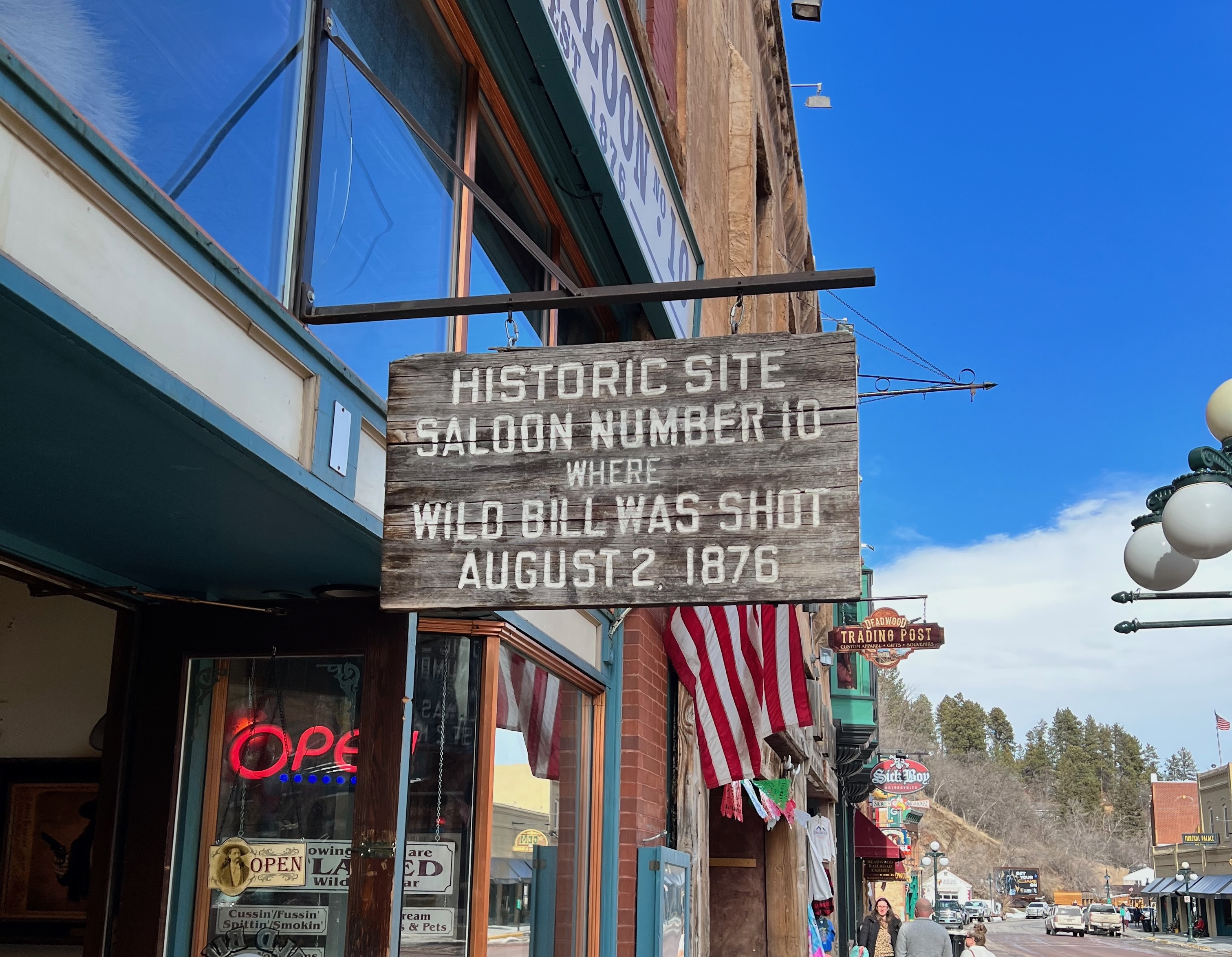
There's a bar on Main Street in Deadwood, South Dakota, that marks the spot where Wild Bill Hickok was killed. The original building, Nuttal & Mann's Saloon No. 10, burned down in 1879. What stands there now has been a clothing store, a beer hall, a casino, and a souvenir shop. The sign still says it's the same location: 624 Main Street.
Hickok was a legendary figure in the Wild West. He was a lawman, a gunfighter, and a Civil War veteran who came to Deadwood looking for gold. Just a few weeks later on August 2, 1876, a man named Jack McCall walked into the saloon and shot him from behind. The night before, Hickok had humiliated McCall at cards. McCall came back. Hickok, who made a rule of never sitting with his back to the door, broke it that afternoon. The hand he was holding when he died, black aces and black eights, has been called the Dead Man's Hand ever since.
The Black Hills were Lakota land long before the Fort Laramie Treaty of 1868 formalized what the Lakota already knew, that the hills were theirs, permanently, in the language of the document. Then in 1874, George Armstrong Custer led an expedition into the hills and confirmed what rumors had been circulating for years. There was gold. The treaty did not survive that confirmation. The government did not honor it. Miners flooded in, and Deadwood grew up overnight, illegal and ungovernable, in the middle of someone else's sacred land. The Lakota's resistance was answered with the Great Sioux War of 1876, the same year Hickok sat down at that poker table for the last time.
Deadwood had no law and no government. It had saloons, gamblers, and men who came west carrying everything they owned and hoping the ground would make them whole. The hills rise steep around it, pine-covered and close. Standing there, you understand something about why so many came here and why they stayed. The scale of the land does something to you. It makes your ambitions feel both enormous and absurd.
America needed a story for what it was doing. It found one in Manifest Destiny, the belief, held with religious certainty, that this continent was meant to be claimed, that the westward push was not conquest but fulfillment. The people already living on the land were written out of that story. Hickok fit the mythology perfectly. The lone lawman. The steady hand. Order to the wilderness. That he was shot from behind by a man with a grudge, in a town that had no legal right to exist, was not the kind of detail the myth required.
We have always had a gold rush. The opportunity changes, but the mythology does not.
In 1849 it was California. In 1876 it was right here. Then it was oil in Texas, dot-coms in San Francisco. Today it is artificial intelligence. The promised returns are different, but the pattern is identical. The allure of overnight fortunes. Visionary founders who saw what others missed and moved fast enough to matter. And always, underneath the celebration, the quieter accounting of who paid the price for someone else's discovery.
I spent an afternoon in Wild Bill's Bar asking the bartender more questions about Deadwood and Hickok than he probably expected on a Sunday. He answered all of them, graciously. When you stepped through the curtain into the recreated Original Saloon No. 10, the first thing you noticed was how small it was. How close Hickok was to the door. There was nowhere to hide in a room that size. The final card game was set on the table, cards scattered everywhere, a pistol, a black hat. Outside on Main Street, tourists stopped to photograph the building that isn't the original building. Some walked up the hill to Mount Moriah Cemetery, where Hickok is buried alongside Calamity Jane, who asked to be laid next to him in death because the myth, apparently, organized even that. Others headed to the Broken Boot Gold Mine or the Black Hills Mining Museum to stand where the fortune-seekers once stood.
The landscape changes. The technology changes. The stories we tell ourselves about ambition, opportunity, and what we are entitled to inherit are remarkably durable.
The Dead Man's Hand is still the most famous losing hand in American history. Held by a man who never saw what was coming.
Some things don't change.
-- Michael Holland
The full journey -- forty communities, twenty-eight states, three continents -- lives at michaeljholland.com.
Finding America chronicles a multi-year odyssey through the places, histories, and myths that shape American life.
Since 2022, Michael Holland has lived in more than forty communities, exploring what becomes visible when we slow down, stay longer, and experience places on their own terms. It is a search for a country that is often very different from the one we debate.
The odyssey continues.