Issue 15 · August 28, 2026
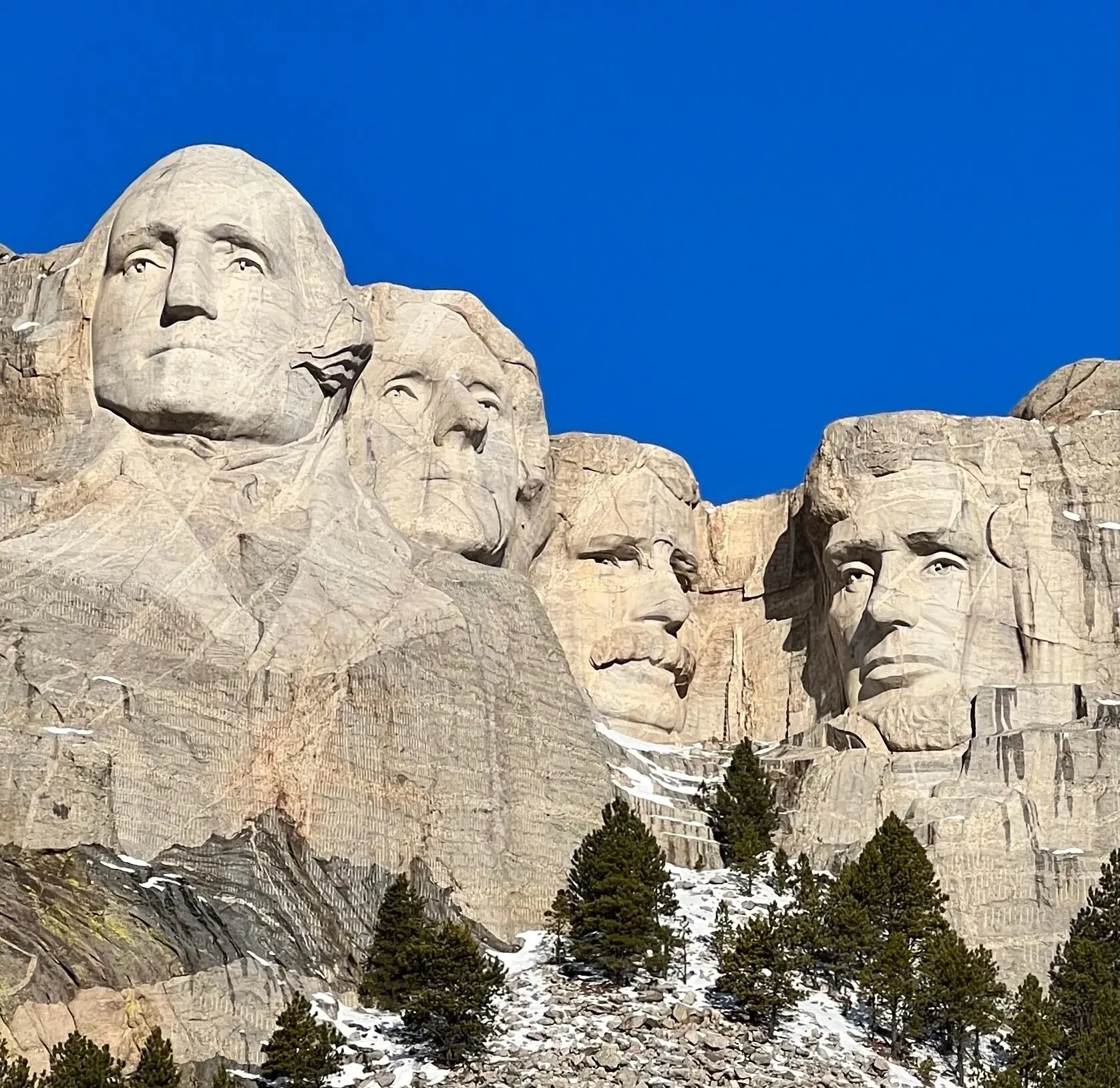
Shortly before eight on a February morning, I came around a bend in the Black Hills and saw four faces in the distance.
I had seen Mount Rushmore countless times before. Photographs, television, movies, the familiar American image of Washington, Jefferson, Roosevelt and Lincoln emerging from granite. But now it was suddenly there, across the trees, smaller from the road than I expected and at the same time almost impossible to believe. I pulled over and took a picture.
I had driven more than nine hours across South Dakota to see it. The night before, I had arrived in Rapid City after stops in Sioux Falls and at Wall Drug. Now, I was pulling into Mount Rushmore.
There was almost nobody there.
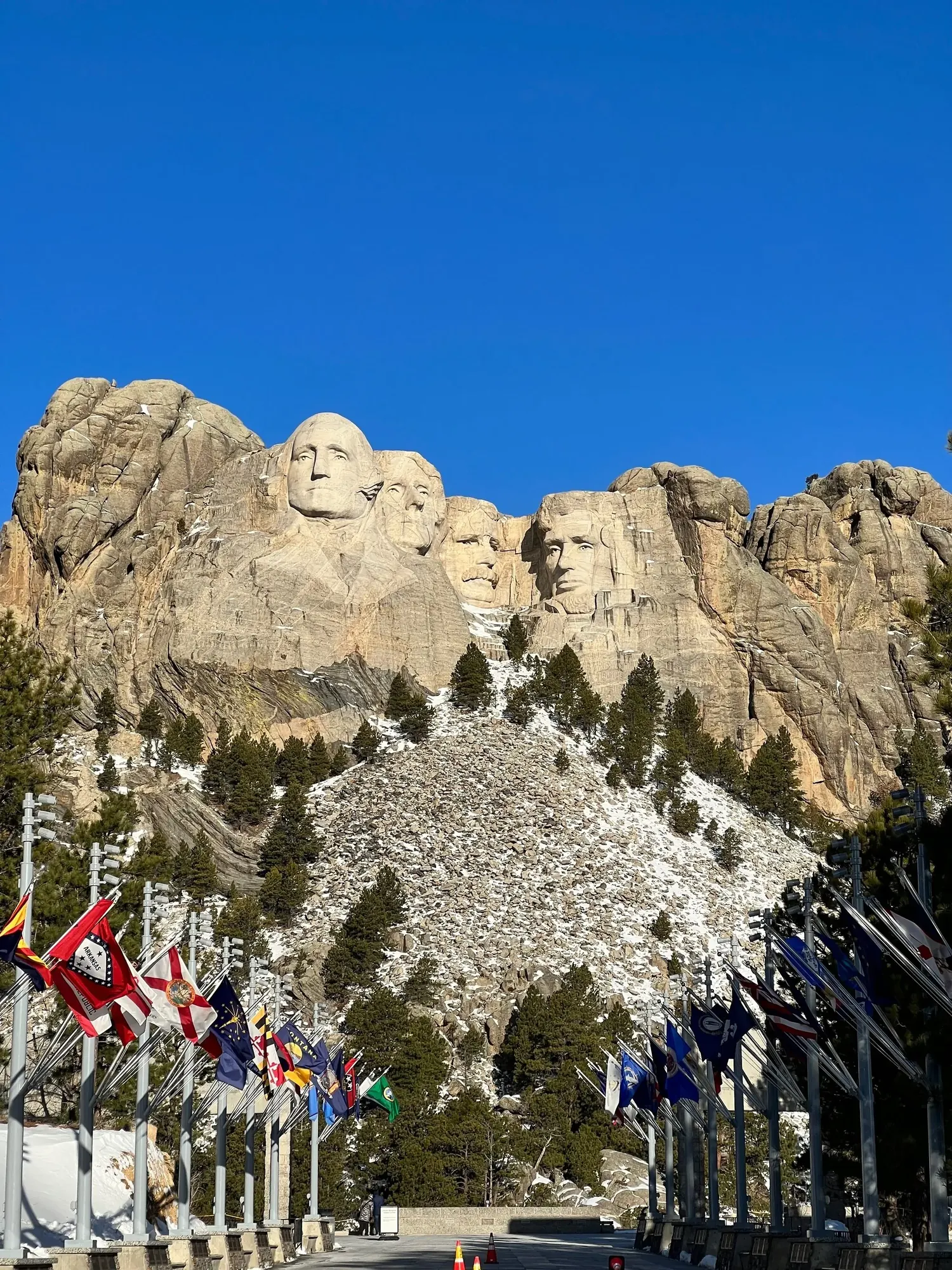
Workers and rangers were beginning their day, but crowds were absent. I walked through the entrance, past a bust of Gutzon Borglum sculpted by his son Lincoln, and onto the broad Avenue of Flags looking for New York, New Jersey and Connecticut among the states. At the end of the walkway, the four 60-foot presidential faces framed the view. I could simply stand there and stare.
I heard voices behind me as two women were taking pictures. They asked if I would take their picture. I did, and then they offered to take mine. We kept talking. Soon a man walked over and joined us. I learned that he was the younger woman's husband, a veteran who had been stationed in Korea many years earlier, where they had met. The other woman was her mother. They were visiting Mount Rushmore together, and soon we were walking toward the dining area.
They told me we had to get the ice cream. It was about 8:30 in the morning and in my mind I thought, "I guess I'm having ice cream for breakfast."
Of all the logistical research I had done on Mount Rushmore, I had somehow missed the famous ice cream. But they seemed certain, so I followed them. We ate vanilla ice cream, which I learned was made from a recipe Thomas Jefferson recorded in the 1780s, and talked about America, our experiences of living abroad, and the way distance from your own country can change what you notice about it.
At some point, they asked whether I had been to the Crazy Horse Memorial.
No, I said. It was closer than I thought, they told me.
I knew about Crazy Horse and Little Bighorn. I knew the memorial was somewhere in the Black Hills, and I already intended to spend part of this trip learning more about Indigenous history before continuing north toward Standing Rock Sioux Reservation. What I had not fully grasped was how close the two mountains were: only about seventeen miles apart.
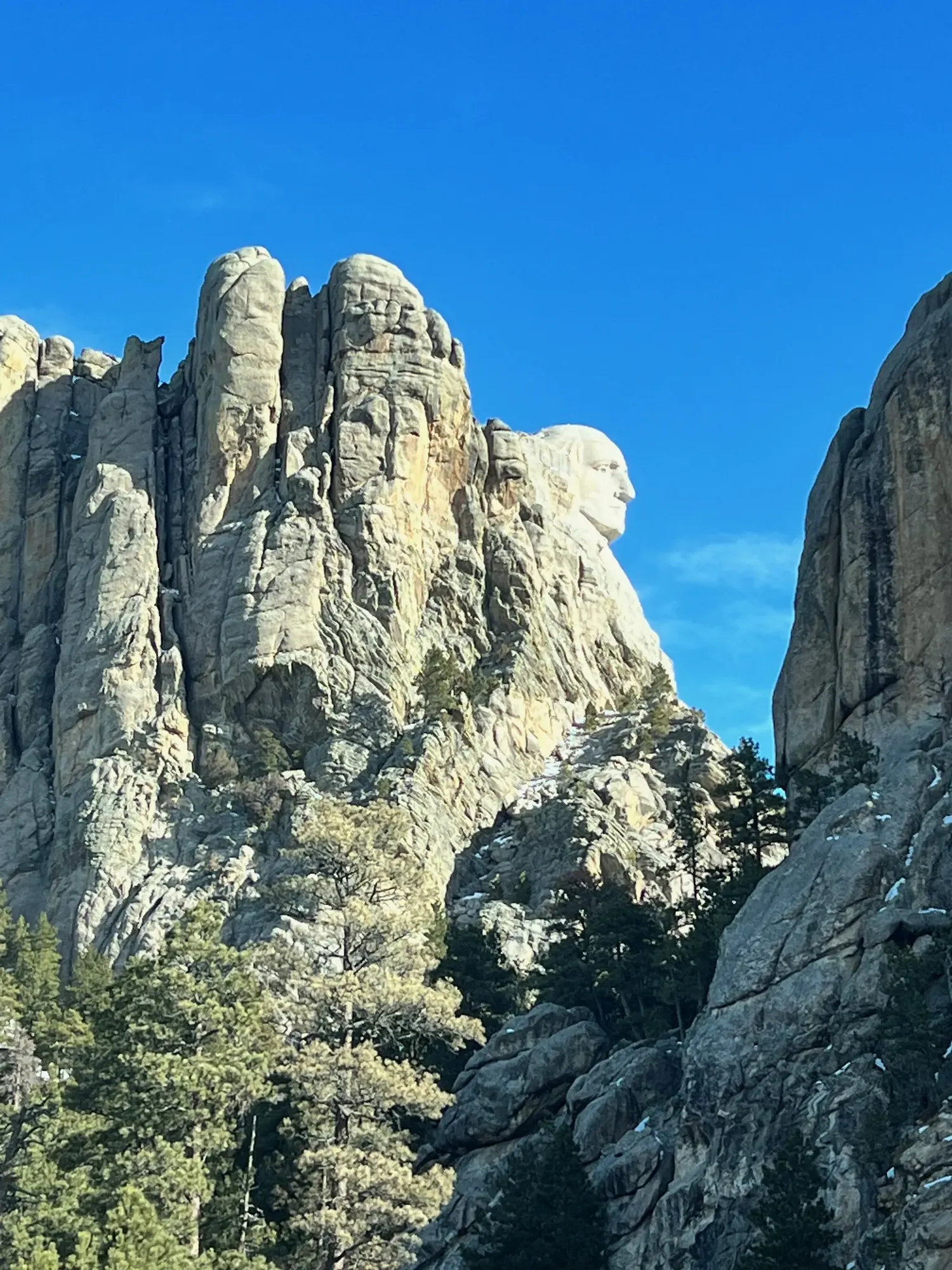
By 9:20, I was leaving Rushmore for Thunderhead Mountain. The winding road gave me another view of Washington, this time in profile, and I slowed for another photograph. Then there were hills, trees, and mostly empty winter campgrounds and RV parks waiting for another season.
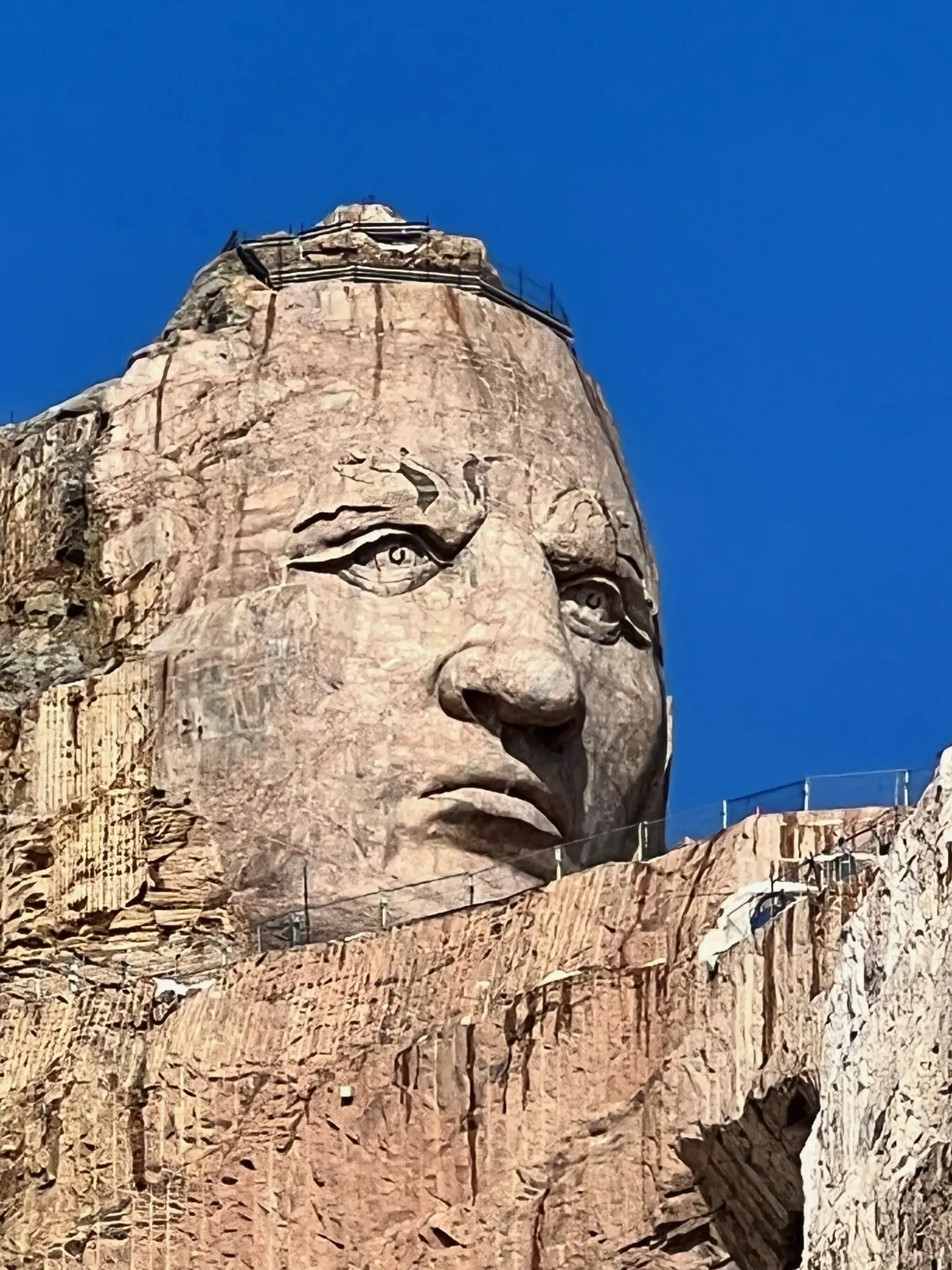
I turned onto Avenue of the Chiefs, and another carved mountain appeared ahead of me.
At 9:46, I reached the entrance to the Crazy Horse Memorial and stopped for a photograph. Again, my first response was not an argument. It was awe.
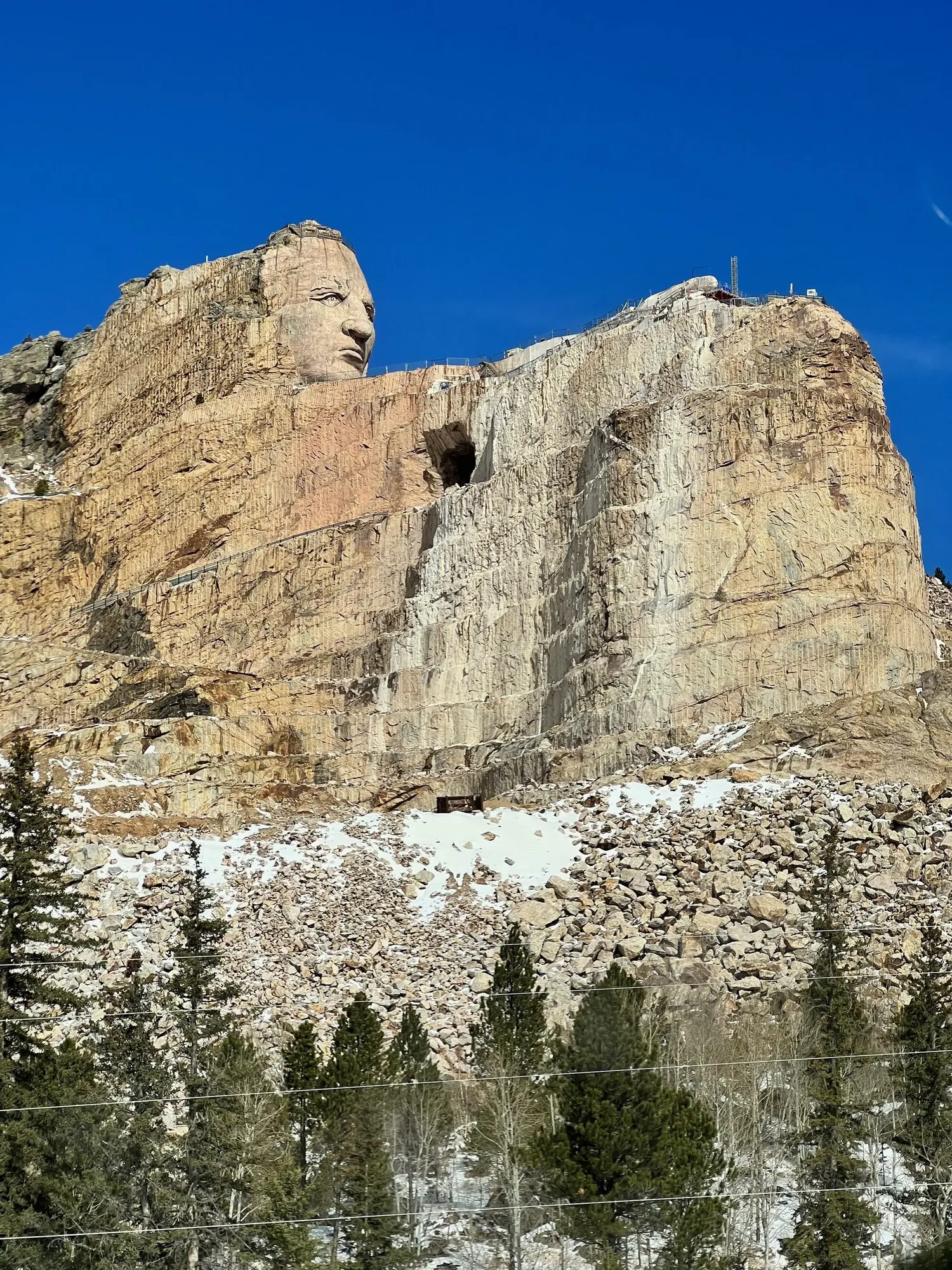
The carving was far from the visitor center, the completed face emerging from an enormous mass of unfinished mountain. I had seen photographs, but photographs did little to prepare me for the scale of what was underway. The face was there; other portions of the intended figure were still being drawn out of the granite. Inside the Welcome Center, I watched a film about the memorial's history, saw the Tribal Flags Collection, and moved through exhibits at the two museums there: the Indian Museum of North America, and the Ziolkowski Family Life Collection.
I learned more about Henry Standing Bear, the Lakota elder who sought a monument demonstrating that Native people also had heroes worthy of recognition, and about Korczak Ziolkowski, whose family continues the work today. I saw the sculptor's studio and a model of the finished memorial: Crazy Horse on horseback, his arm extended over the animal's head.
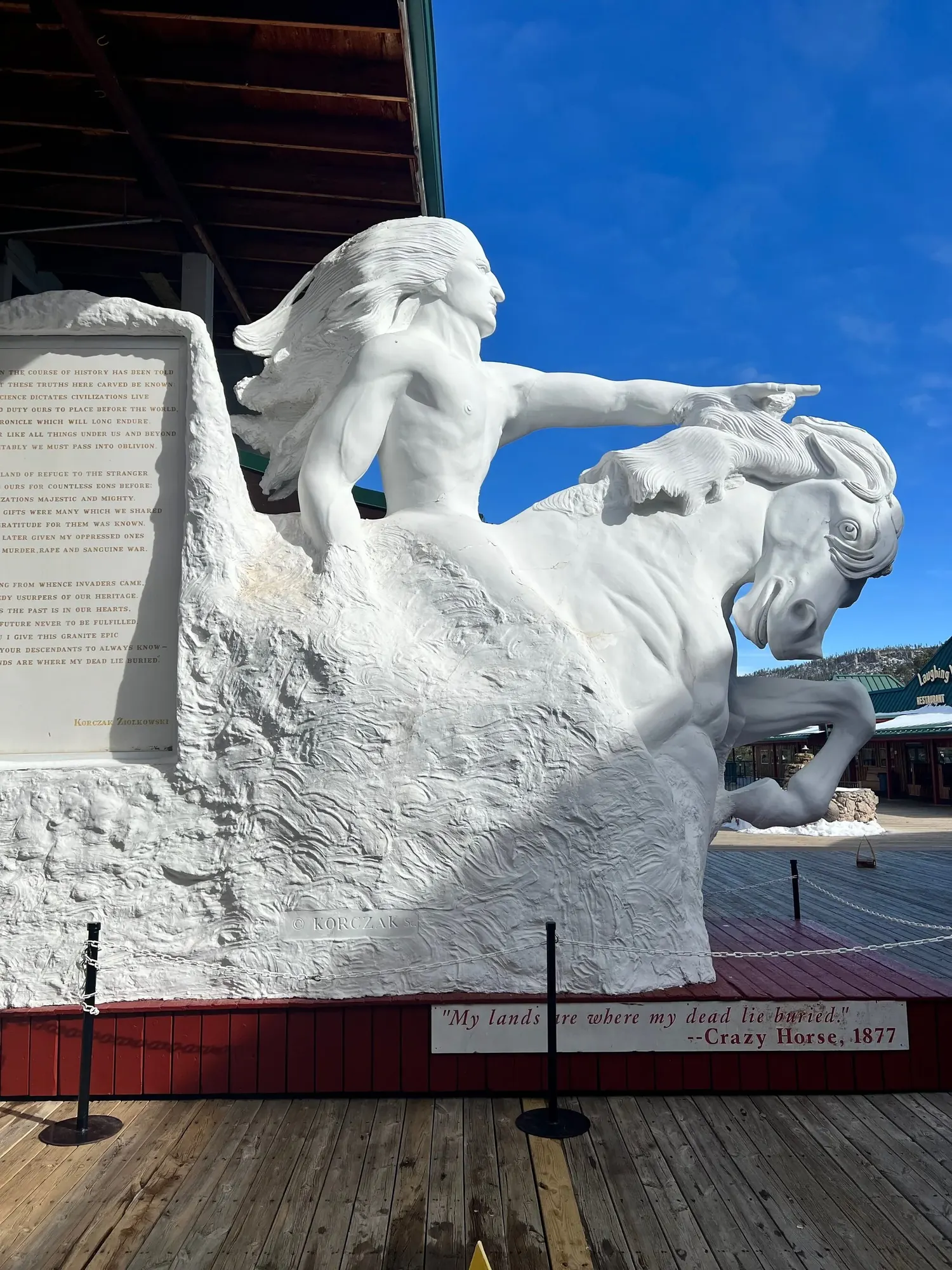
Near the exit was the "Rock Box," a large bin filled with chunks of granite blasted from the mountain during the carving, free for visitors to take as souvenirs. Beside it was a donation box and a sign encouraging visitors to give. I put money in the box, took two pieces small enough to close in my hand, and slipped them into my pocket.
At the time, the contrast seemed almost self-evident: four American presidents on one mountain; seventeen miles away, a Lakota leader who fought the expansion those presidents had come to represent. One monument finished, the other still being made. There was much about that comparison I did not know that morning.
The Black Hills are sacred to the Lakota and other Indigenous peoples of the Northern Plains. The 1868 Treaty of Fort Laramie recognized Sioux possession of the Black Hills; after gold was discovered, the United States took the land. The Crazy Horse Memorial itself had begun with Henry Standing Bear's genuine desire that Native heroes receive monumental recognition. But that origin did not settle the question of the memorial.
Some Lakota people, including relatives of Crazy Horse, have objected to carving his likeness into a sacred mountain. There is no single Lakota judgment of the project.
And there is another complication I did not know that morning: no authenticated photograph of Crazy Horse is known. The certainty of that enormous stone face rests, in part, upon uncertainty about the face it represents.
In the photographs from that morning, the faces still demand attention. Washington, Jefferson, Roosevelt and Lincoln fill one frame. Crazy Horse fills another.
But around Crazy Horse's completed face is something much larger: exposed granite, carving scars, snow, trees, and an enormous unfinished mountain.
Most of it is still there.