Issue 16 · September 4, 2026
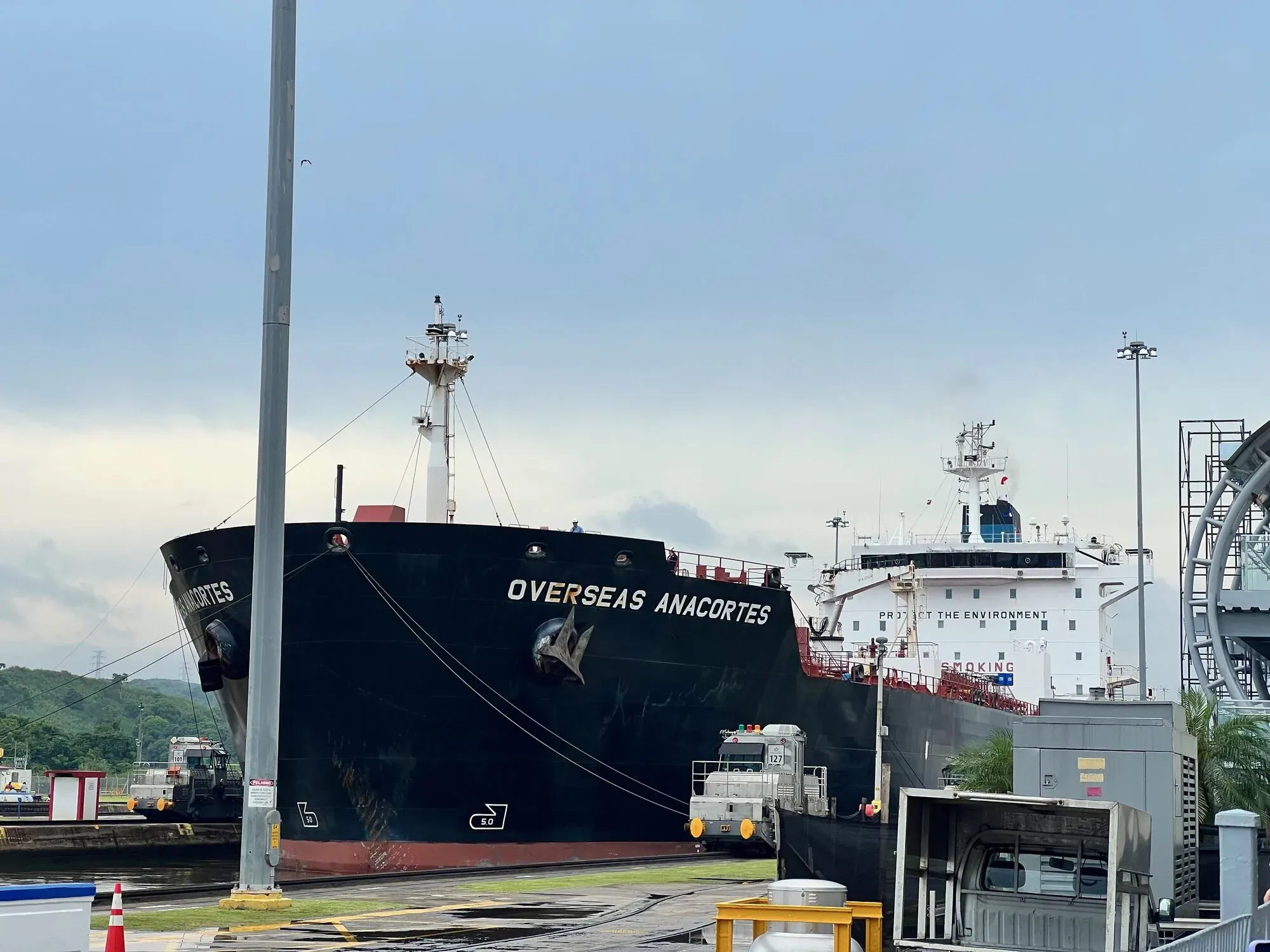
From the bleachers at the Miraflores Locks, a ship looked too large for the channel holding it. Its dark hull filled the view. After a tugboat guided the ship into place, gray rail vehicles called "mules" moved beside it, their steel cables keeping the hull centered between the concrete walls. A few Canal workers walked alongside. The pavement was wet. A line of forest sat beyond the machinery. Beyond the original chambers, the containers of another enormous ship rose above the trees as it passed through the expanded Cocolí Locks.
Then the ship began to disappear.
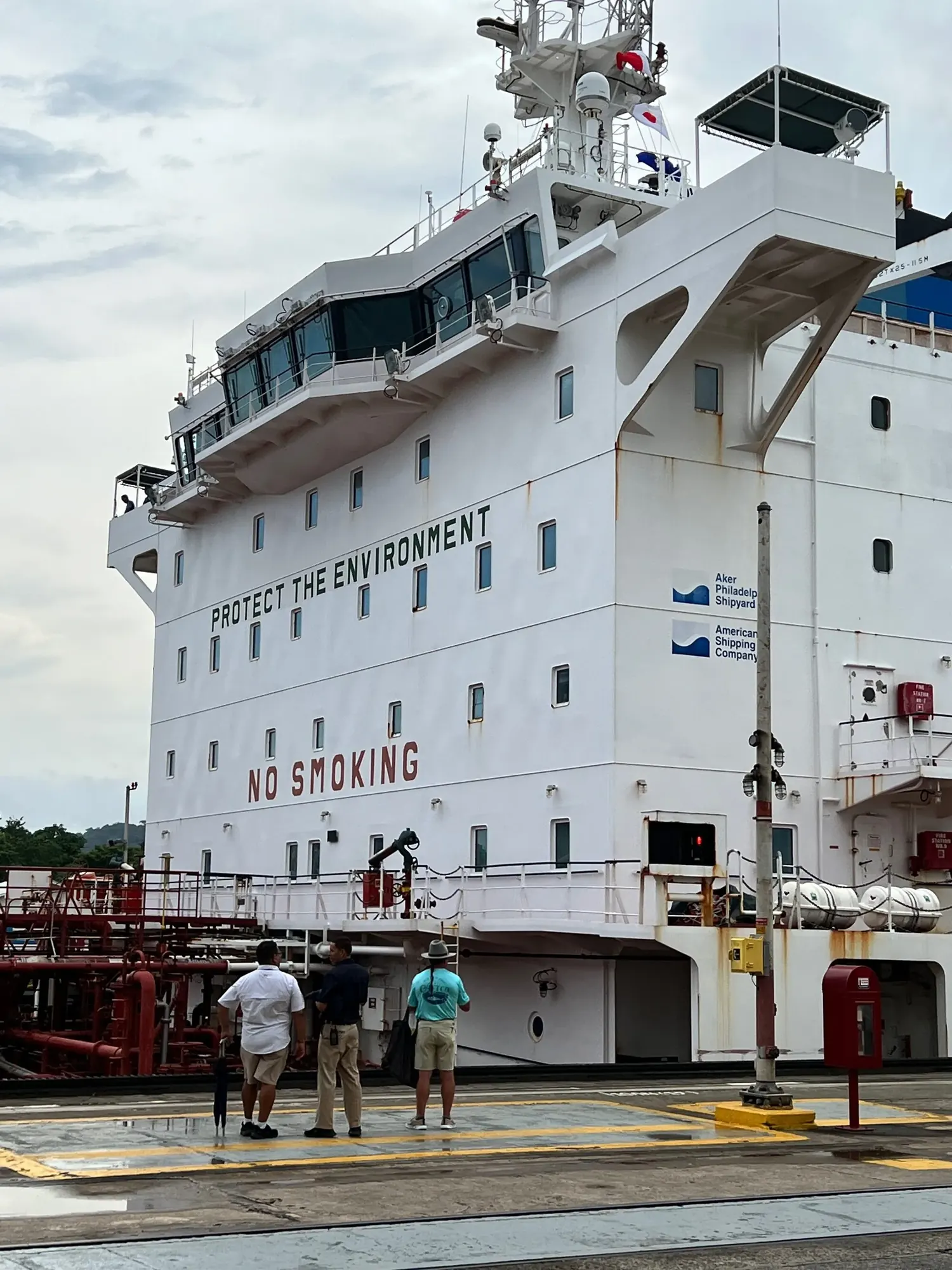
It did not go anywhere, not in the usual sense. The water inside the lock was lowering, carrying the ship with it. The name Overseas Anacortes remained visible above the dark hull. Then mostly the white superstructure remained, its windows and railings passing the building marked "Miraflores Locks Panama Canal 1913." The passage through the locks took about forty-five minutes, slow enough to watch and too large to absorb at once.
I had come to Panama partly for this. I had flown through Tocumen International Airport twice before, looking down on ships gathered in the Bay of Panama, but I had never stood beside the Canal. The day before I went to Miraflores, I had visited the Panama Canal Museum in Casco Viejo. I had encountered the familiar construction story there: the failed French effort, the American completion, the dams, locks and excavation. I had also encountered a history that made that familiar version harder to repeat.
The shorthand I had inherited was that America built the Panama Canal. It was not exactly false. It was radically incomplete.
The Canal administration recruited tens of thousands of workers from the Caribbean to perform much of the physical labor. It divided its employees between gold and silver rolls. Although officials presented the distinction as one of currency and skill, it became a racial order: the administration generally assigned white American workers to the gold roll and Black Caribbean workers to the silver.
One museum panel showed how far that division extended. Two photographs placed children of Silver Roll workers outside their school in Culebra beside children of Gold Roll workers outside theirs in Gorgona. The rolls followed workers beyond wages into their housing, transportation, public facilities and the classrooms their children entered.
I carried two things from the museum to Miraflores: astonishment at what people had managed to build across the isthmus, and horror at the way many of the people who built it had been treated. I used the word guilt when I recorded the memory later. It still does not feel quite right. I did not build the Canal. But I could not sit in the bleachers and admire it as though I had not seen those children.
Another ship entered. Over the intercom, an announcer spoke in Spanish, explaining each stage as the vessel moved through the locks. Below, Canal workers again walked alongside while the locomotives moved beside the hull. Everything proceeded in measured increments: narrowing distances, lowering water, an immense vessel descending in stages. I had expected the Canal to be impressive. I had not expected something so enormous to move with such precision.
The Canal joined two oceans by refusing the simple idea of a channel at sea level. The original locks use water and gravity to raise ships to Gatún Lake and lower them again. A vessel crossing Panama climbs into the interior, crosses a freshwater lake, then descends toward the other ocean.
That dependence was invisible from the rain-darkened pavement at Miraflores. A wet day did not mean the watershed held enough water. The same lake system used for lockages also supplies drinking water for much of Panama. During the severe drought of 2023 and 2024, the Canal Authority restricted traffic as Gatún Lake fell. The movement I watched at Miraflores still depended on rain falling beyond the bleachers.
Water was not the only limit on the old story of mastery. For much of the twentieth century, the United States did not merely operate the Canal. It controlled the Canal Zone, a strip of land running through the middle of another country. The Torrijos-Carter Treaties began dismantling that arrangement in 1979. Panama assumed full control of the Canal at the end of 1999.
From the bleachers, none of that history announced itself. There were ships, lock walls, water, people and machines. More than a century after the Canal opened, a Panamanian operation carried commercial traffic through with the practiced rhythm of ordinary work.
I stayed for several hours. I watched four vessels pass through. Each repeated the operation without making it less astonishing. A hull entered high in the lock. Water moved. Steel descended. The upper decks remained visible after most of the ship had dropped below my view.
Below the bleachers, another ship entered the lock. Its hull was still descending when I began to lose sight of it.