Issue 09 · July 17, 2026
There is a narrow street in Philadelphia that was never part of the plan.
Elfreth's Alley sits in Old City, a short walk from where America tells its largest stories about itself. Independence Hall. The Liberty Bell. Preserved rooms, public monuments, and names nearly every American recognizes. The country's founding is presented nearby with all the scale and ceremony we have learned to expect.
The alley began with a more practical problem. People needed another way to reach the river.
As Philadelphia grew into a busy port city, artisans and merchants crowded into properties near the waterfront, where goods and materials arrived. In 1703, landowners Arthur Wells and John Gilbert opened a cart path between their properties so tradesmen could move between Front and Second Streets. The route later took the name of Jeremiah Elfreth, a blacksmith and land developer.
More than three hundred years later, people still live there.
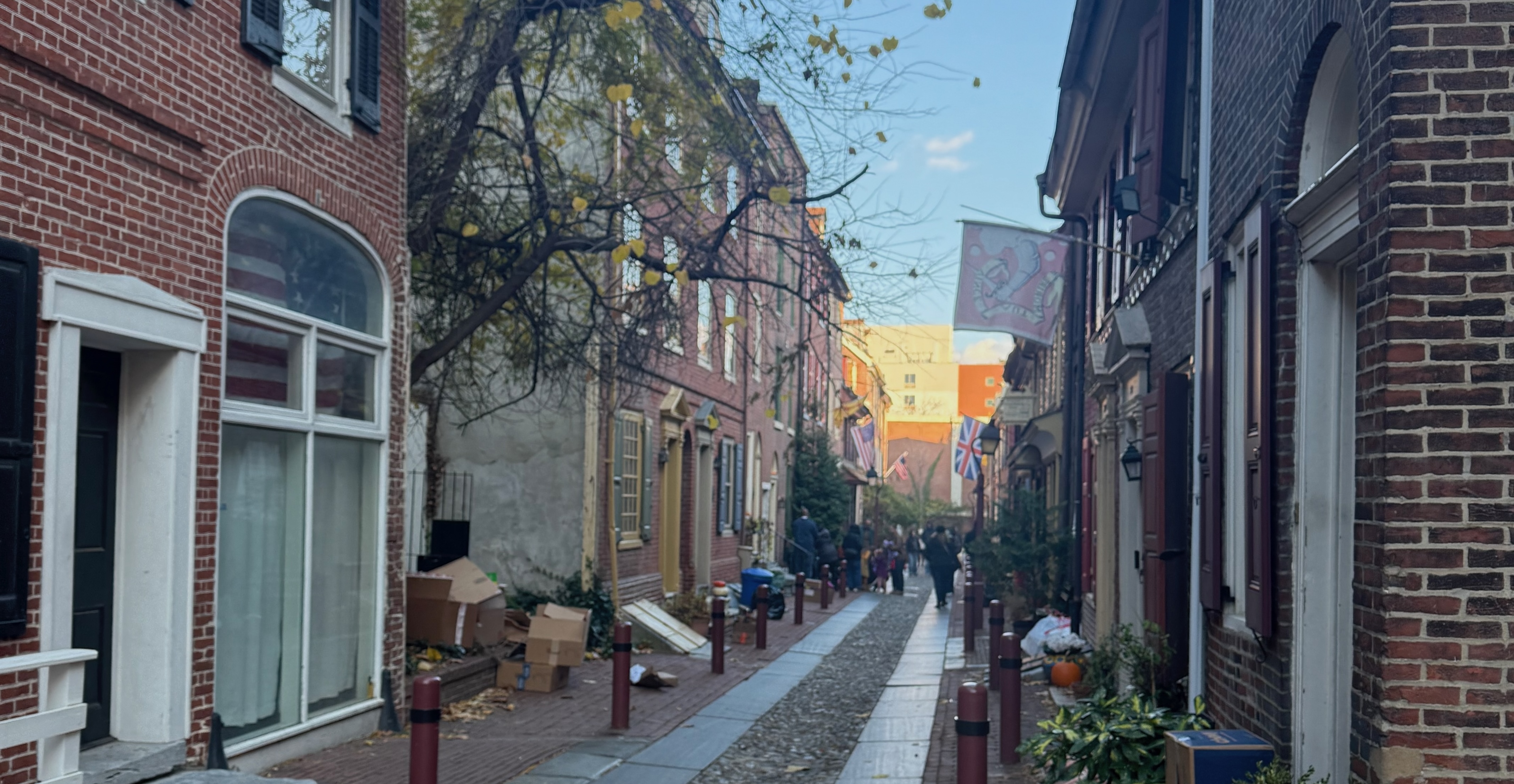
The scale of the city changes as soon as you enter. Brick houses stand close to the walkway, with small windows, worn steps, and doors only a few feet from the people passing. Garbage bins sit beside colonial facades. Visitors pause beneath the marker at the entrance, then move slowly along a street built for horses, carts, and people on foot.
Halfway down the alley, a photographer was arranging a young couple in front of one of the doorways for what appeared to be engagement photographs. She adjusted the couple's pose, stepped back, then made another small adjustment. Another couple and photographer seemed to be waiting nearby for their turn.
Behind them was a front door and a mail slot belonging to one of the houses. Elfreth's Alley is still a residential community. A life being lived, standing in as a backdrop for the beginning of someone else's.
That tension is difficult to miss. People come to photograph its beauty and age. Other people receive mail there, carry groceries inside, place trash outside, and hear visitors gathering a few feet from their windows.
Most of the surviving houses were built between 1720 and 1830. The people who lived there were not, for the most part, the people who filled American textbooks. They were artisans, merchants, and tradespeople who lived close to the river because that was where the work was.
A few blocks away, we remember the men who debated the country into existence. Elfreth's Alley holds a quieter record of the people who helped keep the city functioning while they did it. The contrast does not diminish the founders. It widens the frame.
That made me wonder how the alley itself had survived. By the early twentieth century, deterioration threatened many of the houses. Resident Dolly Ottey led efforts to form the Elfreth's Alley Association in 1934, beginning a decades-long campaign by residents and local historians that preserved the street. Their work did not recover the names or stories of everyone who had lived there. It did keep the street from being eliminated from the landscape of Old City.
Today, two houses, numbers 124 and 126, form the Elfreth's Alley Museum. The museum tells the story of the working people who helped build the country through labor and commerce. The rest of the alley remains what it has long been: a place where people live.
I stopped at the doorways and tried to imagine the ordinary life held behind them, aware that imagination can only go so far. A shoemaker might have returned through one of these doors. A child might once have struggled to reach a latch. Meals were prepared, work was discussed, and people waited for others to come home. The details are mostly gone. The physical traces remain.
Walking Elfreth's Alley made me reconsider what I mean by progress. I had often thought of progress in terms of what is new, what replaces what came before, and what promises to carry us forward. Here, progress looked different: a place continuing to serve as a home long after the world that built it had disappeared.
The people who first used the cart path had no reason to believe anyone would still be walking it three centuries later. Most left no monument and no famous words. What remains is brick, wood, stone, and the dimensions of a street shaped by the practical needs of daily life.
Down the alley, the photographer continued working. The couple shifted slightly to catch the brick in better light. Somewhere behind the photographer, the woman was laughing at something the man had said. Neither of them was looking at the house at all.
-- Michael Holland
The full journey -- forty communities, twenty-eight states, three continents -- lives at michaeljholland.com.
Finding America chronicles a multi-year odyssey through the places, histories, and myths that shape American life.
Since 2022, Michael Holland has lived in more than forty communities, exploring what becomes visible when we slow down, stay longer, and experience places on their own terms. It is a search for a country that is often very different from the one we debate.
The odyssey continues.