Issue 10 · July 24, 2026
There is a ferry from Liberty Square that carries you across Charleston Harbor toward Fort Sumter. As we moved farther from the city, the fort came slowly into view, sitting low against the water. I had read about it, studied it, and imagined it long before I saw it. By the time we drew closer, I felt the building excitement of finally reaching one of those places where history had become physical.
Then the scale of it registered. Fort Sumter was small.
The word fort had given me something larger in my mind, a massive military installation with towering walls and wide defenses. Instead, there was a little island of brick in the middle of the harbor, exposed on every side. The closer we came, the harder it was to understand how a place this compact could carry so much of the country's history.
That smallness changed the story.
I had first encountered Fort Sumter as most Americans do, through a sentence in a history lesson: the Civil War began at Fort Sumter. Later, while living in Charleston, I read Erik Larson's The Demon of Unrest, his account of the months of uncertainty and threat leading toward the first shots of the war. The fort became more than a name on a page. It became a place I wanted to enter, a way to stand where the abstraction of history had once become immediate.
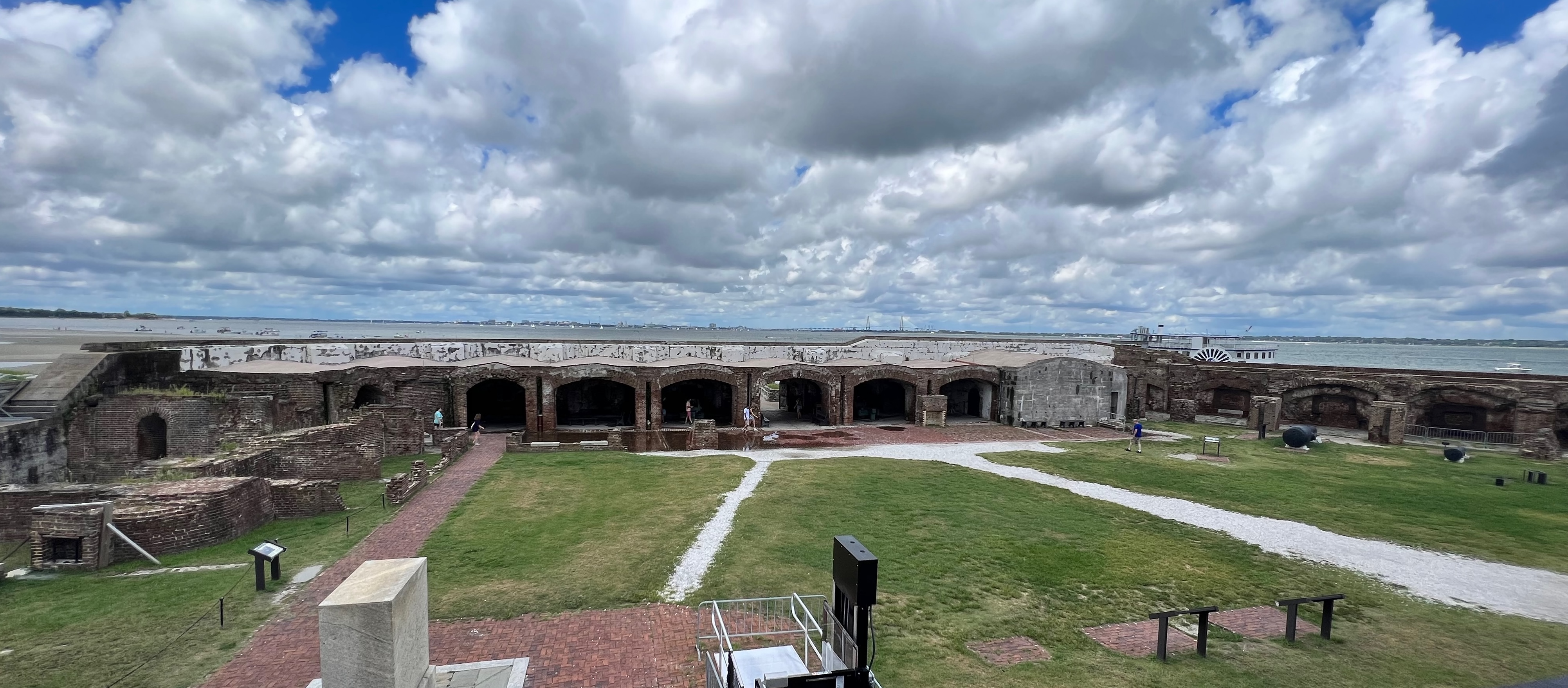
After leaving the ferry, I walked through the gate and into the open interior. Visitors moved along paths and through the arched chambers. Large black cannons remained inside the walls, some mounted on long green carriages, others resting outdoors on stone supports. Across the parade ground, the brickwork showed its age and damage. Above it all, the American flag moved against a bright sky broken by large clouds.
When you visit, there is no guided tour. We were given time to wander, read the exhibits, enter the casemates, look through the gun openings, and move close to the artillery. The freedom to explore made the experience more intimate. It also left room for the mind to work.
Standing inside the fort, it was difficult not to think about the Union soldiers stationed there in April 1861. They occupied an unfinished and isolated position. Their supplies were limited. Their artillery could not adequately answer the batteries positioned around them. From inside those low walls, the isolation was impossible to miss.
There was nowhere to go.
No forest offered cover. No road led away. No route allowed them to retreat once the shelling began. They were surrounded by forces with the advantage of land, distance, and position. Looking through the openings where the guns once faced the shore, I tried to imagine what it meant to remain there while cannon fire came from around the harbor and struck the brick.
The excitement I had felt on the ferry gave way to something quieter. I had wanted to stand inside a pivotal moment in American history. Once there, the significance of the ground felt less dramatic than solemn. The fort did not make the past feel grand. It made it feel exposed.
April 12, 1861. A date easier to hold than the years of argument, compromise, delay, and refusal that had prepared it. Fort Sumter gave the country a location for the rupture. It did not create what had already been building.
There were no deaths from Confederate fire during the opening bombardment. The first Union fatality came after the surrender, when a cannon exploded during a salute to the American flag. The battle that opened the deadliest war in American history was not itself a scene of mass death. Its consequence lay in what followed, as political crisis gave way to mobilization, battle, destruction, and four years of war.
Inside the museum, the flag carried that history more quietly than the cannons did. Its fabric was faded and uneven behind glass, the stars gathered in one corner, the red and white stripes worn by time. Major Robert Anderson lowered the United States flag when the fort surrendered. Four years later, he returned to raise it again over the ruins. The ceremony took place on April 14, 1865, the day Abraham Lincoln was assassinated.
The sequence feels almost too exact: surrender, war, return, assassination. Yet standing there, the flag did not offer a simple ending. The Union survived. Slavery was abolished. The country that emerged remained wounded, contested, and unfinished.
Outside, the present-day flag flew above the damaged walls. Visitors crossed the open ground beneath it, moving between the cannons, the exhibits, and the remains of the fort before the ferry carried us back toward Charleston. The island was still small. The harbor still surrounded it. The walls still looked insufficient for the history they had been asked to hold.
-- Michael Holland
The full journey -- forty communities, twenty-eight states, three continents -- lives at michaeljholland.com.
Finding America chronicles a multi-year odyssey through the places, histories, and myths that shape American life.
Since 2022, Michael Holland has lived in more than forty communities, exploring what becomes visible when we slow down, stay longer, and experience places on their own terms. It is a search for a country that is often very different from the one we debate.
The odyssey continues.