Issue 11 · July 31, 2026
The ride from downtown El Paso to Ysleta del Sur Pueblo took about twenty-five minutes. For much of it, the border remained visible from the highway: fencing, patrol vehicles, checkpoints, and, beyond them, communities in Mexico that appeared close even when the machinery of crossing made them feel farther away. My Uber driver told me that members of his family still lived in Juárez and that they tried to see one another when they could. I don't remember everything he said, only the ordinary way he spoke about a political boundary running through the geography of his family.
I had sought out Ysleta del Sur Pueblo after learning about the Tigua people. Ysleta has been their home for more than three hundred years, yet it sat less than fifteen miles from where I was staying. Traveling toward it felt like moving closer to the edge of the country. I went first to the Pueblo's Cultural Center, where signs asked visitors not to photograph the museum exhibits, out of respect for the community and what was being shared. I put my phone away.
By then, I had been traveling for months through places I wanted to remember, taking thousands of photographs of buildings, streets, memorials, and landscapes. The photographs had become part of how I moved through the country, allowing me to preserve what I had seen and return to it later. At the Cultural Center, looking could not automatically become collecting. I had come hoping to honor its history, but the request made clear that being present did not entitle me to possess what had been placed before me.
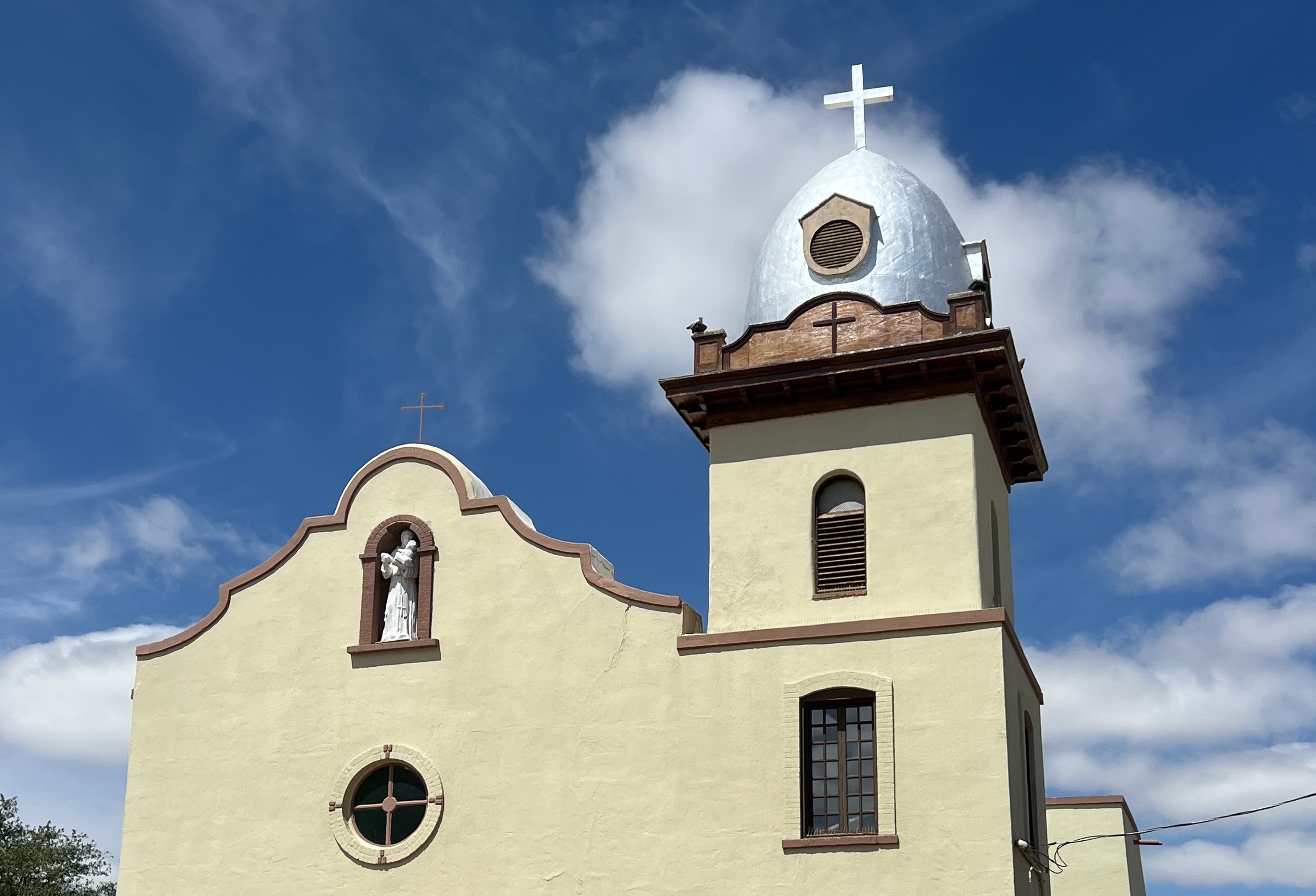
From the Cultural Center, I made my way to the Ysleta Mission. Founded in 1682, the church stood beneath a bright sky, its pale façade rising toward a silver-colored dome and white cross. A bell rested within a low stucco frame in the courtyard. The building was beautiful in the immediate, disarming way old churches often are, even when what appears old has been repaired, reconstructed, and altered across generations.
I entered through the gift shop and spoke with a woman working there. She asked where I was from and I told her that I had come to El Paso to learn more about its border communities and Indigenous history. She graciously allowed me to enter the church. Before leaving, I bought a prayer card for Saint Patrick and we spoke again about the parish.
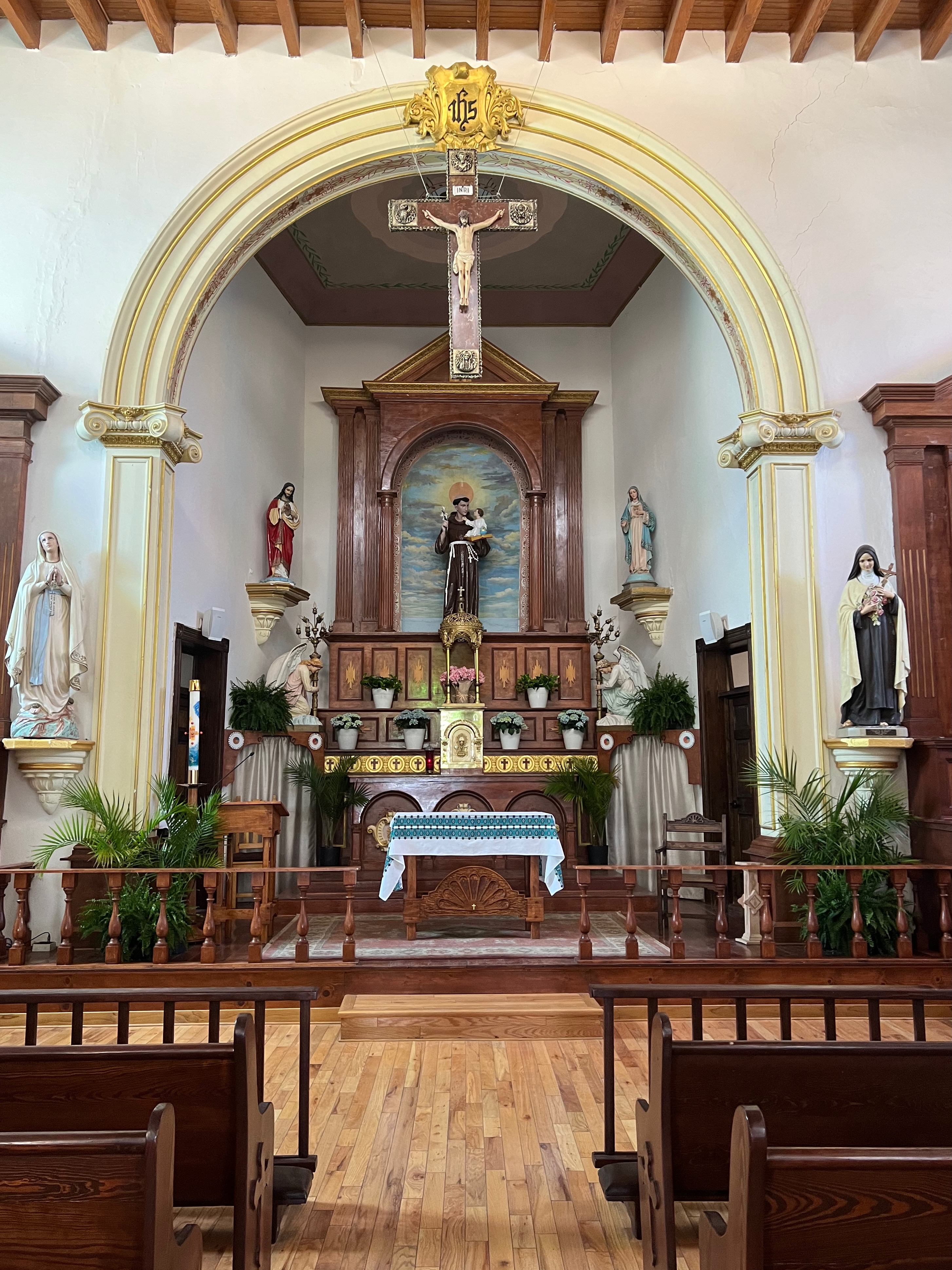
The chapel was smaller than I expected. Rows of polished wooden pews faced a narrow sanctuary crowded with flowers, plants, statues, carved wood, and a crucifix suspended beneath the arch. Exposed beams ran the length of the ceiling. Sunlight entered through tall windows and fell across the center aisle. The mission was not an exhibit preserving a completed past. It remained a parish. The flowers would need tending, the altar would be prepared again, and people would return to the pews.
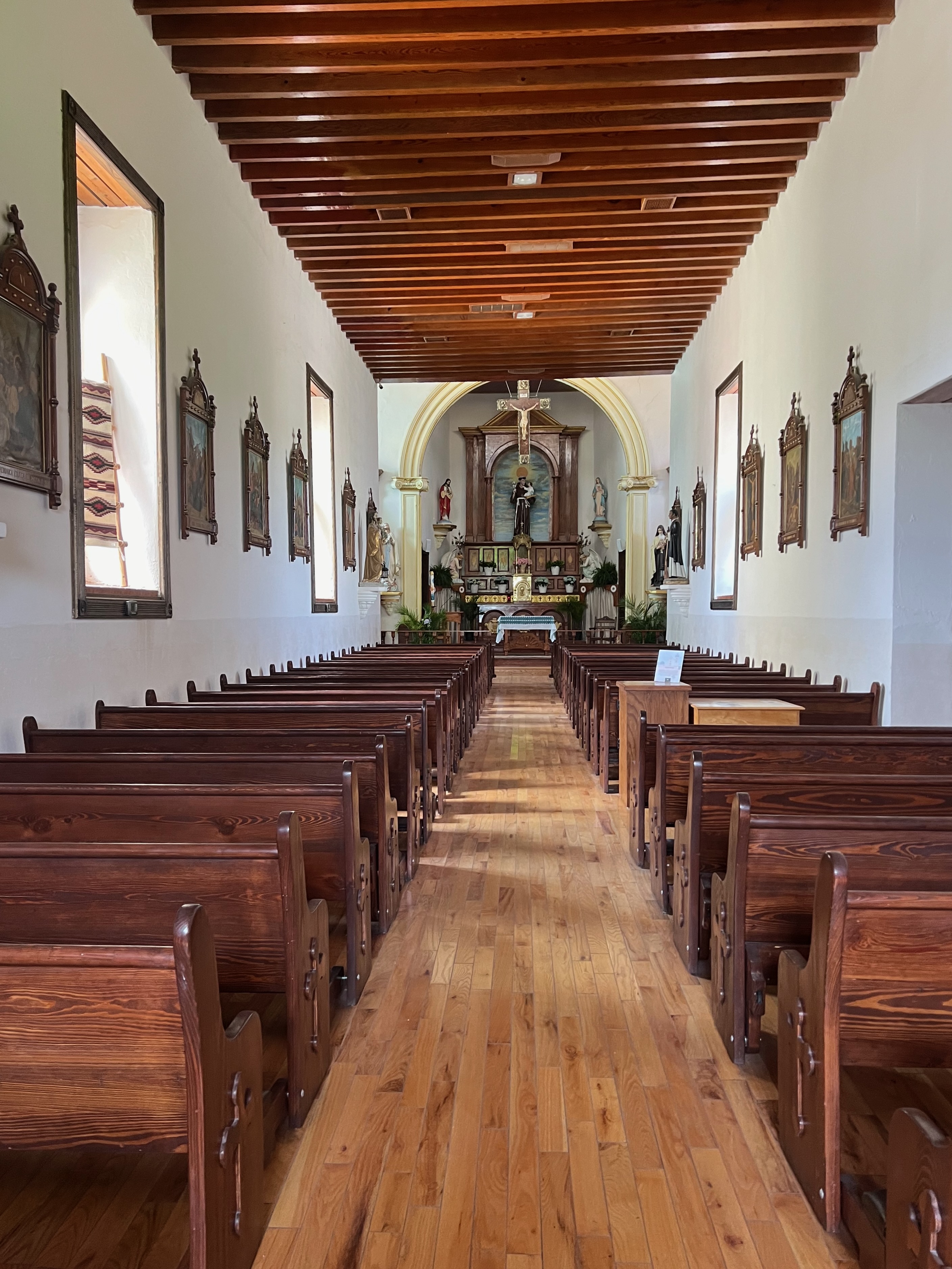
I took photographs inside the chapel, then put the phone aside and sat for a while to pray. I try to do this whenever I enter a church while traveling. It is a small ritual that allows me to slow down, offer gratitude, and ask for help. I don't remember what I prayed for that day, and I can't claim it produced an immediate revelation. I had arrived thinking of Ysleta Mission as the oldest continuously operated parish in the state of Texas, one of those places that might bring the distant past close enough to touch. The history complicated that expectation.
The Tigua ancestors who established Ysleta del Sur came south from Isleta Pueblo, in present-day New Mexico, during the upheaval surrounding the Pueblo Revolt of 1680. The Pueblo's own account describes them as having been captured and forced to travel hundreds of miles with retreating Spanish forces. Other historical accounts say that they "accompanied" the Spanish, a word that produces a gentler founding story but obscures the coercion within it. The mission emerged from a colonial system intended to convert and govern Indigenous people. It was also built, inhabited, adapted, and sustained by the Tigua themselves.
To understand the church only as an instrument of colonization would ignore the generations who incorporated it into their communal and spiritual lives. To celebrate it as a harmonious meeting of traditions would make the unequal power of its origins disappear. I could recognize the tension, but I also had to recognize the limits of my own visit. I had come to learn and to pay respect. I had not spent enough time with the people of Ysleta to speak for what the mission meant to them.
The building offered its own warning against mistaking purity for continuity. The church standing there was not the untouched mission of its founding. Flooding damaged earlier structures, and a later fire harmed the roof and bell tower. Its façade and interior changed, and no known original interior features remain. What endured was not a pristine object but a relationship between a community and a place that had been renewed through use, repair, worship, and time.
The Tigua continue to honor Saint Anthony and a statue of him occupies a niche above the entrance. The present-day parish is dedicated to Our Lady of Mount Carmel, a name that carried an unexpected familiarity. The church across from my grandmother's apartment in Queens bore the same dedication, and it was where she attended Mass. The connection did not make my Catholic inheritance equivalent to the Tigua community's experience, but it kept me from treating Catholicism as something that belonged only to another people's history. I had entered the chapel as a visitor and observer, but I had also sat in its pews and prayed within a tradition that had reached both communities through very different histories.
Ysleta also unsettled the geography that had accompanied me from downtown El Paso. The community existed before Texas, before the United States governed the region, and before the present border hardened into the political fact visible from the highway. During the nineteenth century, the Rio Grande changed course. Treaties and governments later treated the river's altered channel as a boundary, eventually placing Ysleta within the United States. The people did not cross the modern border to enter America. Geography shifted, sovereignties changed, and America arrived around them.