Issue 17 · September 11, 2026
Twenty-five years.
It is difficult for me to write those words and connect them to September 11, 2001. I can still remember that morning. News alerts said a plane had hit the North Tower. Disbelief and confusion. How? Like many, I turned on the television to see what had happened only to witness the second plane hit the South Tower. I watched helplessly as the buildings collapsed.
I can still remember the sound of the fighter jets flying over suburban New Jersey as I looked up at the blue sky. I remember driving the New Jersey Turnpike that afternoon and looking toward a skyline I had known my entire life. I had been inside those towers. I had ridden the elevators. I had looked out over the city from Windows on the World. They were gone.
Whenever I return to New York City, I try to make my way downtown. Most recently, on a bitterly cold day this past January, I went back to the 9/11 Memorial. The city moves all around you there. Trains arrive beneath these streets. Office workers hurry past. Tourists take photographs. Lower Manhattan has rebuilt itself around the enormous absence at its center.
In the footprints of the North and South Towers, water falls into two dark voids, surrounded by the names of nearly three thousand people who died that day. Some are strangers. Some belong to friends, neighbors and people once separated from us by only a degree or two.
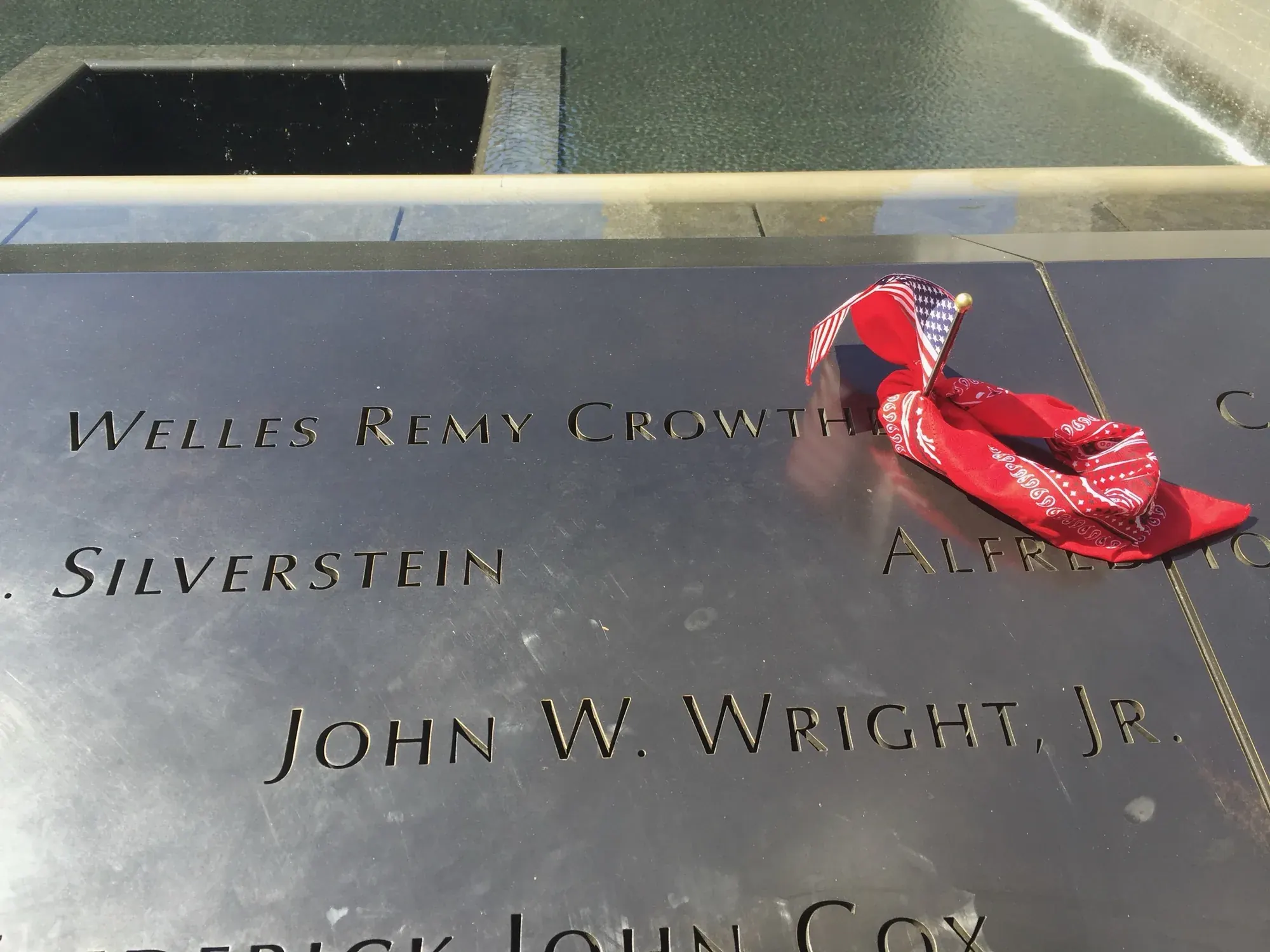
One of those names is Welles Remy Crowther. I came to know his story years after September 11 and on one of my visits to the memorial, I photographed the red bandana someone had placed across his name. I never met Welles, but we both attended Boston College and played lacrosse there, years apart. Those coincidences are not why his story matters, but perhaps they explain why I have always felt a particular connection to it. Welles was 24 years old and working on the 104th floor of the South Tower.
On the 78th-floor sky lobby, he began helping people escape. He directed people toward the stairs, helped the injured and repeatedly returned to help others. Welles never made it out.
For months, no one knew his name. Until May 2002, when Welles' mother Alisson read a New York Times account by survivor Judy Wein. Wein described a young man with a red bandana covering his nose and mouth who had guided people to safety in the South Tower. Welles had carried a red bandana since childhood. She knew immediately it was her son, and survivors later identified him from photographs.
Among the thousands of stories from that morning, here was one that began with people who had survived remembering a stranger by one small detail.
For the past four years, I have been traveling across America and trying to understand the country by spending time in places where its history happened. Fort Sumter, Greenwood, Memphis. I found myself confronting histories that I learned about long before I ever stood where they occurred. Ground Zero always feels different because I remember the world before this place became a memorial. The history I encounter there is also part of my own memory.
A quarter century has gone by and a generation of Americans, including my sons, has now grown up with no memory of September 11. For them, the attacks belong to history in the way so many events belonged to history for me when I was young. For those of us old enough to remember that morning, certain details can still feel remarkably close.
The skyline has changed. Lower Manhattan has changed. America changed after that morning, too.
Yet there are still moments when 25 years seem to disappear. You stand beside the footprints of these two buildings, run your fingers across the names, and remember the people who were there.
Including a 24-year-old man with a red bandana who kept going back upstairs.