Issue 19 · September 25, 2026
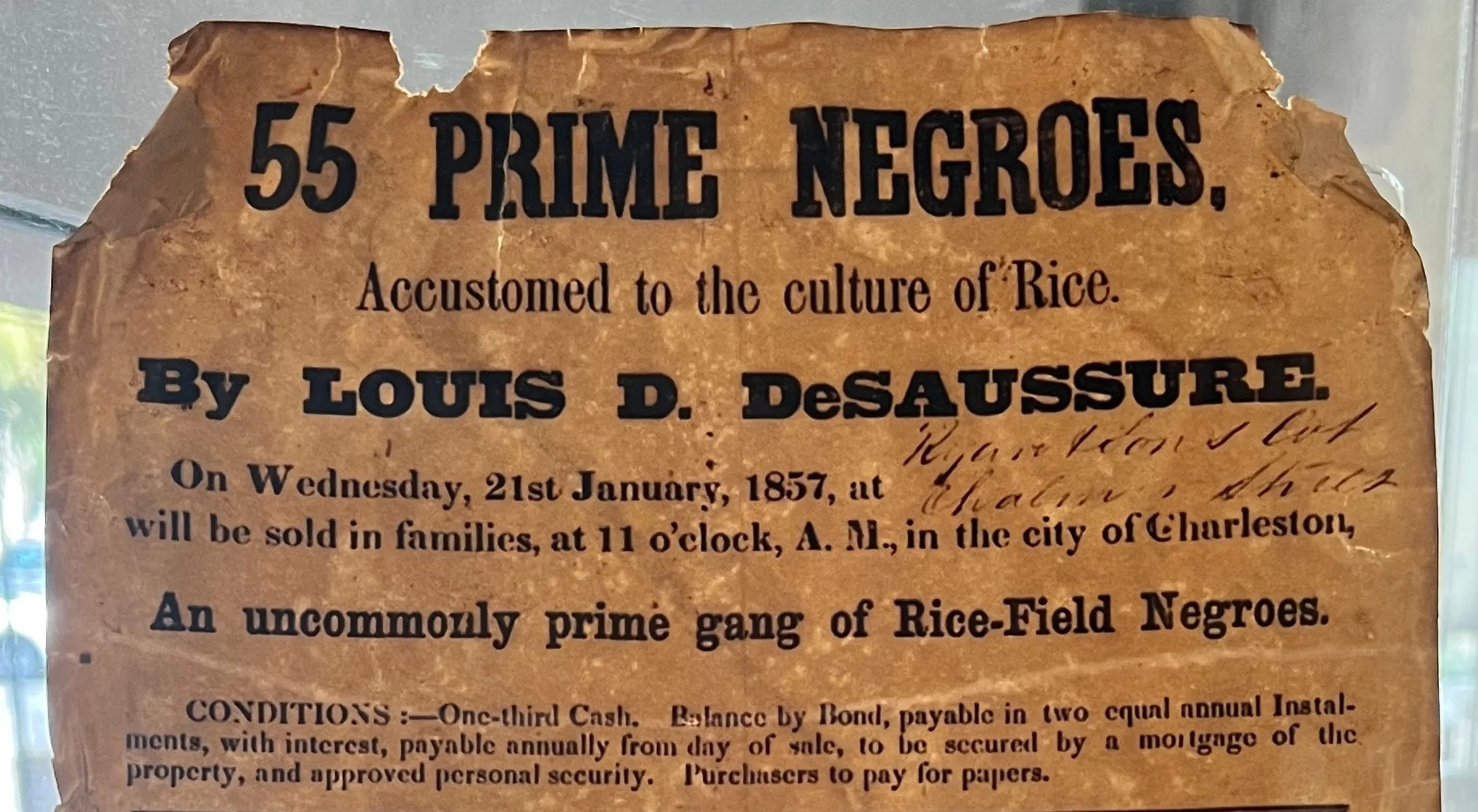
John, fifty, is described as a “trusty driver” and a full hand. Mary, forty, is “prime.” Paddy is sixteen and a cart boy. Lydia is nine. Love is six. Charity is two. A five-month-old infant appears without a name.
They are among the people listed on Louis D. DeSaussure’s broadside for a sale in Charleston on January 21, 1857 as part of “an uncommonly prime gang of Rice-Field Negroes.”
The sheet says they were accustomed to rice cultivation and would be sold “in families.” It gives the terms: one-third cash, the balance paid in two annual installments, interest added, a mortgage and personal security required. The page continues in two columns, recording ages, work capacities, illnesses, impairments, and infants. Handwritten marks cross some entries. Horizontal lines divide one family group from the next.
I photographed the broadside on the second floor of Charleston’s Old Slave Mart Museum. The surviving building on Chalmers Street is small, only one part of what had been Ryan’s Mart. On the first floor, there is an exhibit called “The Price of a Human Being,” which arranges value by age and market category. I knew this history, but standing there confronted me with something knowledge alone had not: the cold ordinariness with which one human being’s value had been calculated by another.
The broadside applied the same method without assigning a dollar amount to each person. Age, labor capacity, illness and impairment became information for a sale. Even families became units within the transaction.
The page preserves dozens more names. Jacob, forty-five, is a full hand, ploughman and wagoneer. Juba, fifty, is a half hand and plantation cook. Clarinda, fourteen, is a house girl. Infants are left unnamed.
Twenty days later, I visited the International African American Museum. The museum stands at Gadsden’s Wharf, where tens of thousands of enslaved Africans disembarked after being brought to America during the transatlantic slave trade.
At IAAM, I photographed Ashley’s Sack, which dates to about 1850. In 1921, Ruth Middleton stitched the names of three women into the cloth: her great-grandmother Rose, her grandmother Ashley, and her own. Ruth’s embroidery records that Rose gave Ashley the sack with a tattered dress, three handfuls of pecans, a braid of her hair, and her wish that the sack would be “filled with my Love always.” Ruth also stitched, “she never saw her again.”
Ashley was nine years old.
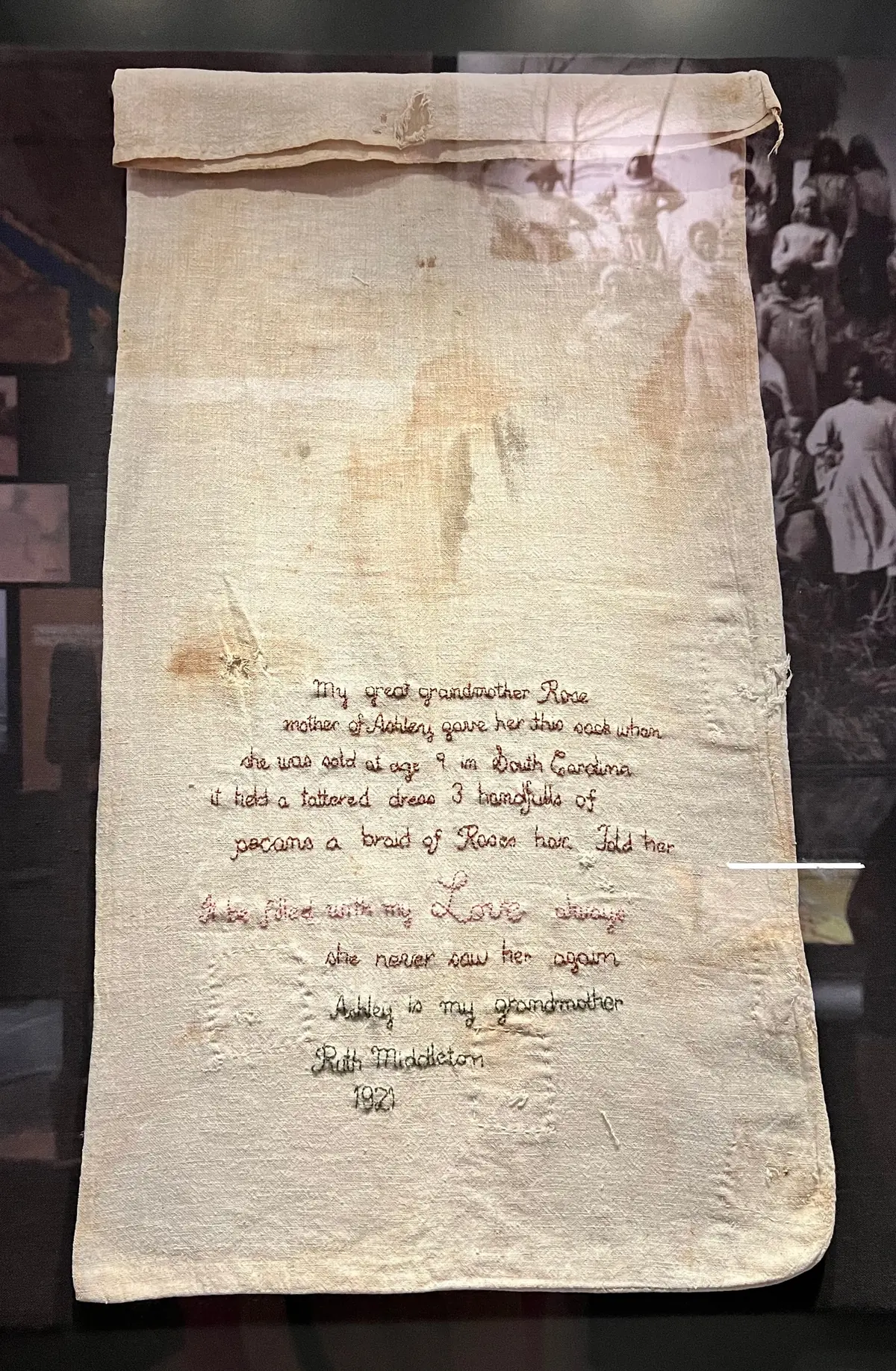
By the time Ruth stitched the words into cloth, the story had crossed generations. I cannot imagine what Rose must have felt when her daughter was taken from her, and I do not pretend that I can.
The surviving evidence does not establish that Ashley was sold in Charleston, at Ryan’s Mart, or at any site I visited. Historian Tiya Miles built her National Book Award-winning All That She Carried around the family keepsake while being direct about the gaps in the documentary record. The sack and its inscription became her major source. The conventional archive could not supply the evidence for a tight reconstruction of Rose and Ashley’s lives.
The auction broadside is a record made by people with the power to sell. Its commercial purpose narrowed human beings into traits a buyer might value, yet it preserved names and family clusters that might otherwise have disappeared. The sack carries a family’s account of relationship, provision, and loss, yet it cannot answer every question that later historians bring to it.
On the broadside, names lead to ages, work, and value. On the sack, names lead to one another: Rose, Ashley, Ruth.