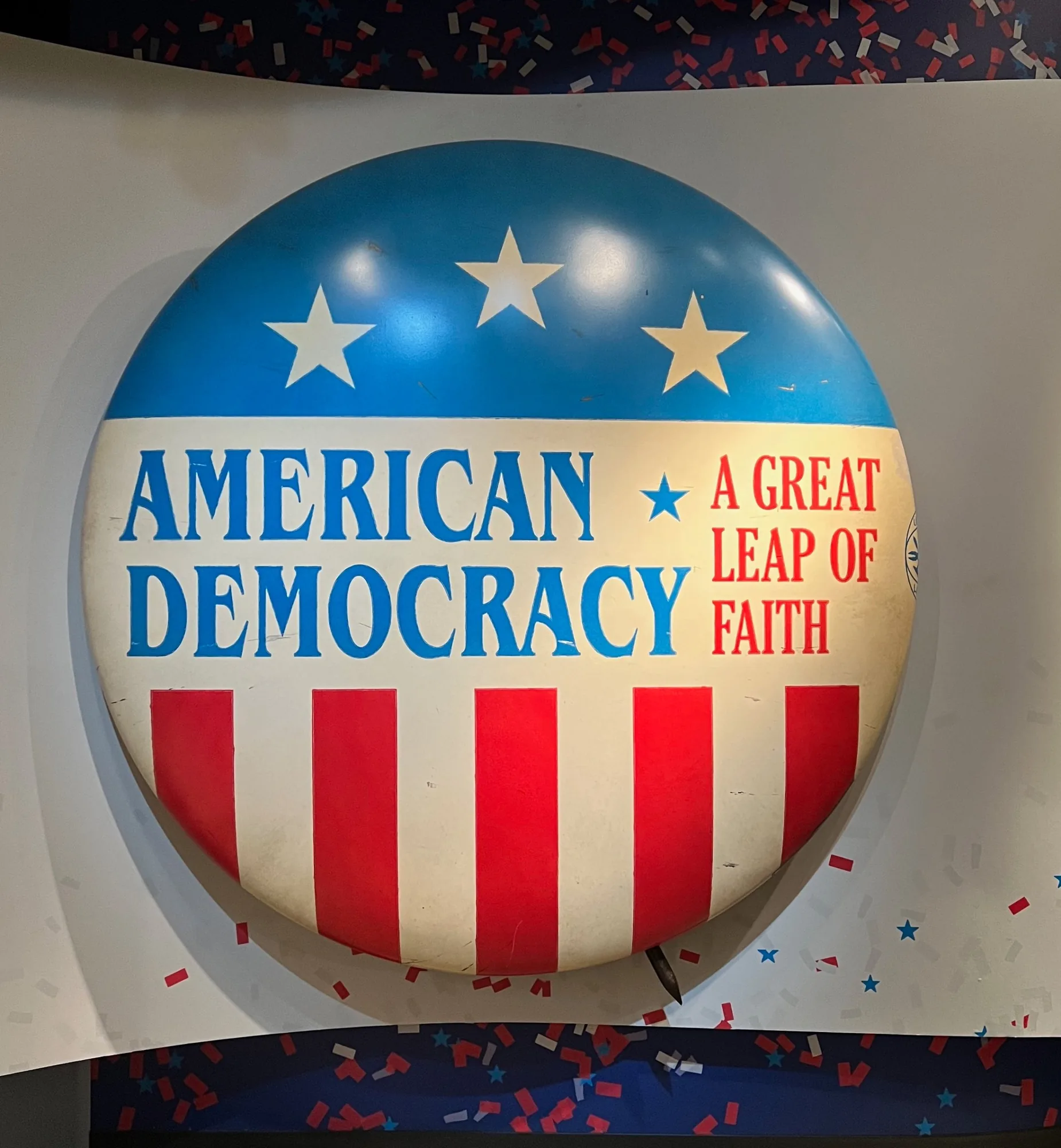
Issue 23 · October 22, 2026
We the People.
Those three words feel less like a description of America than a question: Who are we willing to include in we?
It is a question we have been struggling to answer for centuries. When the delegates gathered in Philadelphia for the Constitutional Convention in 1787, they chose language of extraordinary ambition: We the People of the United States.
Yet Madison, Hamilton, Franklin and the other members of the founding generation established a political community far narrower than those words might suggest. Indigenous nations occupied lands that the expanding United States would claim as its own. Enslaved people were denied freedom. Women were excluded from equal political participation. Political power rested overwhelmingly with white men.
The founding generation left that work unfinished, passing to subsequent generations the responsibility of deciding how expansive we would become. Nearly 240 years later, successive generations have expanded, contested and reimagined its boundaries, often against fierce resistance.
Americans are a curious lot, though, and we can be remarkably good at creating smaller versions of we. We gather around neighborhoods, schools, music, faith, teams and countless other things. We put on the same shirts, sing the same songs and cheer for people we have never met.
I’ve seen that instinct everywhere, from trivia nights and neighborhood festivals to Fourth of July celebrations. I’ve seen thousands gather for a concert, football game, NASCAR race and even a Renaissance festival, where their membership in that community is relatively uncomplicated. And at Peter Dillon’s on East 36th Street in New York, I watched a group of partygoers sing Taylor Swift songs together, knowing not only every word but every moment when they were supposed to move together.
There is something beautiful about our capacity to find one another and to recognize something shared, even if only for a few hours. We know what brings us together. We recognize the people standing beside us.
The American proposition asks something more difficult.
It asks us to sustain a political community that includes people who do not share our histories, beliefs, identities or understanding of what America ought to be. People we may never meet. People whose lives bear little resemblance to our own. Even people whose convictions we find deeply objectionable.
Throughout my life, I rarely had to wonder whether the American we included me. When I looked at the country’s political, corporate and cultural institutions, I saw white men occupying positions of authority.
I was not only included. I was represented.
I could offer some reassuring aphorism about my travels across America, suggesting that beneath our differences, we are all basically the same.
But proximity has complicated some of my assumptions and confirmed others. The road did not cure me of judgment. It made me more conscious of how quickly I practice it. In person, I tend to become curious, even with those whose viewpoints differ considerably from mine. I want to know how someone came to see the world as they do. What experiences shaped them? What have they been taught? What fears, loyalties or convictions inform their understanding of America?
Distance does something different to me.
I can encounter an opinion piece, social media post or panel debate filled with contempt for working-class Americans, immigrants, people of color, Muslims or members of the LGBTQ+ community, and feel my own contempt rising in response. I can find myself wondering how someone could be so willing to deny another person’s dignity, safety or humanity.
And then comes a question I find less comfortable. If someone refuses to recognize the humanity of others, what do I owe that person?
Which brings me back to the Preamble, because We the People of the United States is only the beginning of the sentence.
The Constitution’s opening words do more than identify a political community. They introduce a purpose, an undertaking that cannot be completed simply by declaring ourselves united: in Order to form a more perfect Union.
Form is a verb. And more perfect acknowledges that the work is unfinished.
I don’t think the answer requires me to accept someone’s prejudice, excuse their cruelty or pretend that every argument deserves equal respect. There are convictions worth opposing. Recognizing another person’s humanity cannot mean abandoning the people whose humanity they refuse to recognize.
But I also wonder what happens when our sense of who belongs becomes dependent on who agrees with us, or even who we believe to be decent. There are moments when I find myself resenting entire communities for the politics of some of their members, questioning why I should care about their struggles when they seem indifferent to the struggles of others.
I recognize the contradiction. We have to find ways to live together, argue with one another, defend the rights of those who are vulnerable and hold accountable those who cause harm.
We are not doing that particularly well. I am not even sure how consistently I manage it myself. Four years of traveling through this country have given me plenty of reasons for hope and more than a few reasons to question us, myself included.
But I keep returning to those opening words, not because I believe they describe a union we have achieved, but because they ask something of us that remains profoundly difficult.
-- Michael Holland
The full journey -- forty communities, twenty-eight states, three continents -- lives at michaeljholland.com.
Finding America chronicles a multi-year odyssey through the places, histories, and myths that shape American life.
Since 2022, Michael Holland has lived in more than forty communities, exploring what becomes visible when we slow down, stay longer, and experience places on their own terms. It is a search for a country that is often very different from the one we debate.
The odyssey continues.